
Search
Remove Ads
Advertisement
Search Results

Image
10 Women Scientists Who Changed the World - Discoveries That Transformed Science and Medicine
Throughout history, women in science have made groundbreaking discoveries, often pushing the boundaries of knowledge despite being overlooked and underrecognized. Many...
Definition
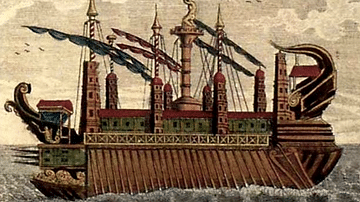
Syracusia
The Syracusia was an ancient sailing vessel designed by Archimedes in the 3rd century BCE. She was fabled as being one of the largest ships ever built in antiquity and as having a sumptuous decor of exotic woods and marble along with...

Article
The Telescope & the Scientific Revolution
The invention of the telescope in 1608 is usually credited to the Dutchman Hans Lippershey. The astronomical telescope became one of the most important of all instruments during the Scientific Revolution when...

Definition
Chanakya
Chanakya (l. c. 350-275 BCE, also known as Kautilya and Vishnugupta) was prime minister under the reign of Chandragupta Maurya (r. c. 321-c.297 BCE), founder of the Mauryan Empire (322-185 BCE). He is best known as the author of the...
Definition
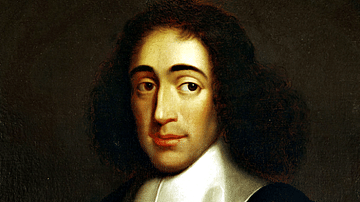
Baruch Spinoza
Baruch Spinoza (1632-1677) was a Dutch philosopher who combined rationalism and metaphysics to create a unique system of thought. Spinoza was held up as an atheist philosopher in the 18th century, but this is not an entirely accurate...

Article
Social, Political & Economic Landscapes in Kautilya's Arthashastra
The Arthashastra (or Arthaśāstra) is one of the oldest surviving treatises on statecraft. There is considerable debate about the dating and authorship of the text; it underwent compilation...

Article
Observatories in the Scientific Revolution
The foundation of observatories during the Scientific Revolution (1500-1700) followed a process of evolution from entirely independent observatories operated by a single astronomer to private observatories...

Article
Passing of Philosophy to Religion: The Death of Hypatia
The death of the philosopher Hypatia of Alexandria (l. c. 370-415) has long been considered the "passage of philosophy to religion", exemplifying the transition from the pagan values of antiquity...

Article
6 Key Instruments of the Scientific Revolution
The Scientific Revolution (1500-1700) was driven by several key inventions, all scientific instruments that became essential to achieving a greater understanding of the world around us. With instruments...

Article
Rosalind Franklin - Equal Co-Discoverer of DNA?
The structure of deoxyribonucleic acid (DNA) was discovered in 1953 by two molecular biologists, James Dewey Watson (1928-2025) and Francis Harry Compton Crick (1916-2004). Watson and Crick were awarded...
