
Search
Remove Ads
Advertisement
Search Results

Article
The Lamentations of Isis and Nephthys
The Lamentations of Isis and Nephthys is an ancient Egyptian text in which the two goddess-sisters call the soul of the god Osiris to rejoin the living. The poem takes the form of a call-and-response liturgy and...

Definition
Creole Mutiny - The Most Successful Slave Revolt in US History
The Creole Mutiny/Creole Rebellion (1841) was an insurrection aboard the brig Creole on 7 November 1841 during which 19 enslaved men (of the 135 men, women, and children held as slaves on board...

Article
Interrelations of Kerma and Pharaonic Egypt
The vacillating nature of Ancient Egypt's associations with the Kingdom of Kerma may be described as one of expansion and contraction; a virtual tug-of-war between rival cultures. Structural changes in Egypt's...

Article
Polybius' Capture of Achaeus and Fall of Sardis
Polybius' Capture of Achaeus and Fall of Sardis is the account of the end of the Siege of Sardis (215-213 BCE) by Antiochus III (aka Antiochus the Great, r. 223-187 BCE) of the Seleucid Empire after the...

Article
Kingdom of Magadha: Wars and Warfare
In ancient India from the 6th century BCE onwards, the kingdom of Magadha (6th century BCE to 4th century BCE) made a mark for itself. Located in the eastern part of India in what is today the state of Bihar, it...
Definition
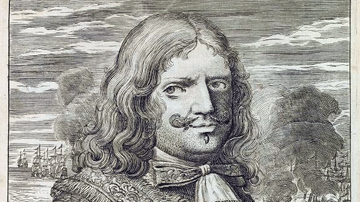
Henry Morgan
Sir Henry Morgan (c. 1635-1688) was a Welsh privateer who operated in the Caribbean against the Spanish Empire and then became Lieutenant Governor of Jamaica. Morgan was a charismatic and able military leader who masterminded devastating...

Article
Plato: The Name and The Poet
Plato (l. c. 424/423 to 348/347 BCE), the Greek philosopher whose works have significantly shaped Western thought and religion, is said to have initially been a poet and playwright and, even if the primary source of...

Article
The Propaganda of Octavian and Mark Antony's Civil War
Propaganda played an important role in Octavian (l. 63 BCE - 14 CE) and Mark Antony's (l. 83 – 30 BCE) civil war, and once victorious at the Battle of Actium (31 BCE), Octavian returned home to become...

Article
The Nûñnĕ′hĭ and Other Spirit Folk
The Nûñnĕ′hĭ are the Cherokee "spirit people", similar to the fairy as sometimes depicted in European medieval folklore, and The Nûñnĕ′hĭ and Other Spirit Folk is a collection of anecdotes about them compiled by...

Interview
Rubin Museum's Faith and Empire: Tibetan Buddhist Art
Faith and Empire: Art and Politics in Tibetan Buddhism, a new exhibition at the Rubin Museum of Art in New York, explores the dynamic historical intersection of politics, religion, and art as reflected...
