
Search
Did you mean: Samhain?
Remove Ads
Advertisement
Search Results

Definition
Upanishads
The Upanishads are the philosophical-religious texts of Hinduism (also known as Sanatan Dharma meaning “Eternal Order” or “Eternal Path”) which develop and explain the fundamental tenets of the religion. The name is translated as...

Definition
Stupa
A stupa (literally “heap” or “pile”) is a reliquary, a shrine containing the remains of a holy or sainted person and/or artifacts (relics) associated with them, originating in India prior to the 5th century BCE as tombs of holy men and...

Definition
Tara
Tara is a female deity in both Hinduism and Buddhism who personifies compassion and offers salvation from the suffering of rebirth and death. She is thought to have been born of empathy for the suffering world and is regularly invoked...
Definition
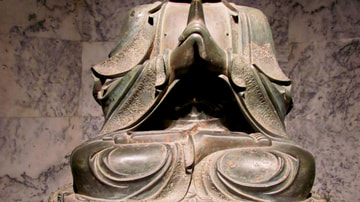
Esoteric Buddhism
Esoteric Buddhism is the mystical interpretation and practice of the belief system founded by the Buddha (known as Sakyamuni Buddha, l. c. 563 - c. 483 BCE). It is known by several names and is characterized by a personal relationship...

Definition
Tibetan Book of the Dead
The Tibetan Book of the Dead is the English translation of the Tibetan texts known as bar-do thos-grol (Bardo Thodol) – “Liberation Through Hearing During the Intermediate State” – and serves as a guide for the soul of...

Definition
Perfection of Wisdom
Perfection of Wisdom is the foundational text of the Mahayana Buddhist school, a kind of anthology of works, thematically linked, composed between c. 50 BCE - c. 600 CE in India by Mahayana Buddhist scribes. It is comprised...

Definition
Siddhartha Gautama
Siddhartha Gautama (better known as the Buddha, l. c. 563 - c. 483 BCE) was, according to legend, a Hindu prince who renounced his position and wealth to seek enlightenment as a spiritual ascetic, attained his goal and, in preaching...

Definition
The Vedas
The Vedas are the religious texts which inform the religion of Hinduism (also known as Sanatan Dharma meaning “Eternal Order” or “Eternal Path”). The term veda means “knowledge” in that they are thought to contain the fundamental knowledge...

Definition
Bhagavad Gita
The Bhagavad Gita (“Song of God” or “Song of the Lord”) is among the most important religious texts of Hinduism and easily the best known. It has been quoted by writers, poets, scientists, theologians, and philosophers – among others...

Article
The Dates of the Buddha
The dates of the Buddha, Siddhartha Gautama, have been a concern of, primarily, Western scholars for well over 100 years now owing to the particularly Western need for precise dating of historical persons and events. The...
