
Search
Remove Ads
Advertisement
Search Results

Definition
Ship Money - The Unpopular Tax
Ship Money was a tax applied by medieval monarchs to English coastal communities to pay for ships for the Royal Navy and so ward off pirates and enemies of the state. During the reign of Charles I of England (r. 1625-1649...

Definition
Chlothar I
Chlothar I (l. c. 498-561) was a Merovingian king of the Franks, the second to rule over a unified Frankish kingdom after his father, Clovis I (l. c. 466-511). When Clovis died in 511, his kingdom was divided up between his four sons...

Definition
Thomas Hobbes
Thomas Hobbes (1588-1679) was an English philosopher who famously summarised his pessimistic view of human nature in his greatest work, Leviathan, published in 1651. Hobbes believed that the life of humanity in the state of nature...

Definition
James Madison - Father of the Constitution
James Madison (1751-1836) was a statesman, diplomat, and a Founding Father of the United States, who served as the fourth US president from 1809 to 1817. He played an important role in the drafting of the United...

Definition
George Armstrong Custer
George Armstrong Custer (l. 1839-1876) was an officer in the US Army, serving in the cavalry from 1861 to 1865 during the American Civil War and the wars against the Plains Indians 1866-1876. Although he became a widely...

Definition
Frederick the Great - Forging the Prussian State
Frederick II of Prussia (1712-1786), better known as Frederick the Great, was one of the most consequential rulers of 18th-century Europe. A scion of the House of Hohenzollern, he came to power in 1740...

Definition
Lydia
Lydia was a region of western Asia Minor which prospered due to its natural resources and position on trading routes between the Mediterranean and Asia. The Kingdom of Lydia flourished in the 7th and 6th centuries BCE and expanded to...

Definition
Pericles
Pericles (l. 495–429 BCE) was a prominent Greek statesman, orator, and general during the Golden Age of Athens. The period in which he led Athens, in fact, has been called the Age of Pericles due to his influence, not only on his city's...
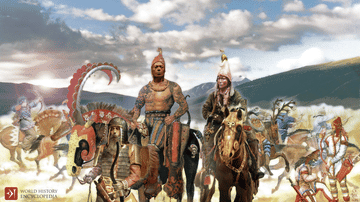
Definition
Scythians
The Scythians were a nomadic people whose culture flourished between the 7th and 3rd century BCE in a territory ranging from Thrace in the west, across the steppe of Central Asia, to the Altai Mountains of Mongolia in the east. This...

Definition
Ancient Argos
Ancient Argos, located in the Peloponnese in Greece, was a major Mycenaean settlement in the Late Bronze Age (1700-1100 BCE) and remained important throughout the Greek, Hellenistic, and Roman periods until its destruction by the...
