
Search
Remove Ads
Advertisement
Search Results

Definition
Sir Thomas More
Sir Thomas More (1478-1535 CE) was a lawyer, scholar, statesman, and Lord Chancellor to Henry VIII of England (r. 1509-1547 CE) who was executed in July 1535 CE for his refusal to endorse Henry's break of the Church in England...

Definition
Thomas Cavendish
Thomas Cavendish (1560-1592 CE) was an Elizabethan mariner and privateer who famously circumnavigated the globe in 1586-88 CE, only the third voyage to do so and the first to set sail with that specific intention. Returning rich...

Definition
Andrea Mantegna
Andrea Mantegna (c. 1431-1506 CE) was an Italian Renaissance artist most famous for his use of foreshortening and other perspective techniques in engravings, paintings, and frescoes. Another common feature of Mantegna's work is...

Definition
Johann Sebastian Bach
Johann Sebastian Bach (1685-1750) was a German organist and composer whose work is today regarded as amongst the finest of mature baroque music (c. 1600-1750). More famous as an organist than as a composer in his own lifetime...
Definition
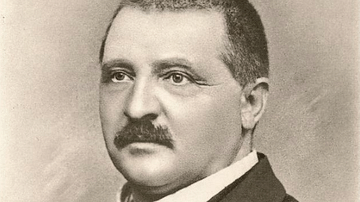
Anton Bruckner
Anton Bruckner (1824-1896) was an Austrian composer, most famous for his nine grand symphonies and his church music. Never quite gaining full recognition for his work until he was in his sixties, Bruckner's music, with its strong...

Image
Basilica of Saint-Denis
The Basilica of Saint-Denis is located in a northern suburb of Paris, France. Extensively renovated by Abbot Suger (1081-1151 CE), a powerful figure in 12th-century CE France, Saint-Denis is considered to be the first-ever...

Article
Byzantine Monasticism
Monasticism, that is individuals devoting themselves to an ascetic life in a monastery for devotional purposes, was an ever-present feature of the Byzantine empire. Monasteries became powerful landowners and a voice to be...

Article
The Monastic Movement: Origins & Purposes
In 313 CE, Constantine the Great (272 – 337 CE) ended the sporadic-yet-terrifying Christian persecutions under the Roman Empire with his “Edict of Milan,” and brought the Christian church under imperial protection...

Article
The Coronation Ceremony of the British Monarchy
The coronation ceremony of the British monarchy as we know it today involves many elements that have been a part of the pageantry ever since the 11th century. Such features of the ceremony carried out...

Article
Holidays in the Elizabethan Era
During the Elizabethan Era (1558-1603 CE), people of all classes greatly looked forward to the many holidays and festivals on offer throughout the year. The vast majority of public holidays were also religious commemorations...
