
Search
Remove Ads
Advertisement
Search Results
Image
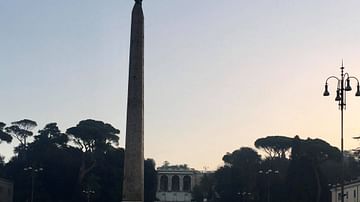
Flaminio Obelisk, Rome
The Flaminio Obelisk is believed to originate from the time of Seti I (1290–1279 BCE), and his son Ramses II (1279-1213 BCE). It was brought to Rome by Emperor Augustus (r. 27 BCE –14 CE) for the Circus Maximus, and today...

Image
Rome: Strategy of Empire
Rome: Strategy of Empire by James Lacey.

Image
Flaminio Obelisk, Rome
The Flaminio Obelisk is believed to originate from the time of Seti I (1290 – 1279 BCE), and his son Ramesses II (1279 - 1213 BCE). It was brought to Rome by Emperor Augustus (r. 27 BCE – 14 CE) for the Circus Maximus, and...

Image
Inscription, Arch of Septimius Severus, Rome
The inscription on the arch of Septimius Severus in Rome (203 CE). It is repeated on both façades, and shows that the triumphal arch was dedicated to Emperor Septimius Severus and his two sons Caracalla...

Image
Relief Panel, Arch of Septimius Severus, Rome
One of the four relief panels and friezes from the arch of Septimius Severus in Rome, 203 CE. The panels, two on each façade, depict battle scenes, seiges, prisoners, and the emperor addressing his troops...

Image
Detail, Arch of Janus, Rome
A detail of the carved niches on the Arch of Janus which stood in the forum Boarium of Rome and was constructed in the 4th century CE most probably to act as a boundary marker.

Collection
Between Alexander & Rome: The Hellenistic Period
The Hellenistic Period refers to the time between the death of Alexander the Great (323 BCE) and the rise of the Roman Empire (32 BCE) in which Greek culture spread throughout the Mediterranean and Near...

Image
Detail, Arch of Septimius Severus, Rome
A column plinth from the arch of Septimius Severus in Rome, 203 CE. The relief sculpture depicts a Roman soldier with a Parthian prisoner.

Article
Paul's Journeys and the Mediterranean Trade
Mediterranean trade increased exponentially at the turn of the first millennium. During Rome's zenith, goods of all sorts began to move in all directions. As a common traveler aboard merchant ships, Paul...
Article
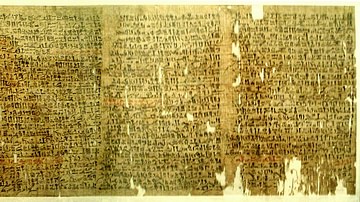
Stories from the Westcar Papyrus
The Westcar Papyrus, dated to the Second Intermediate Period of Egypt (1782 - c.1570 BCE), but most likely written during the Middle Kingdom (2040-1782 BCE), contains some of the most interesting tales from ancient...
