
Search
Remove Ads
Advertisement
Search Results

Article
Pizarro & the Fall of the Inca Empire
In 1533 CE the Inca Empire was the largest in the world. It extended across western South America from Quito in the north to Santiago in the south. However, the lack of integration of conquered peoples into that empire, combined with a civil...

Interview
Rubin Museum's Faith and Empire: Tibetan Buddhist Art
Faith and Empire: Art and Politics in Tibetan Buddhism, a new exhibition at the Rubin Museum of Art in New York, explores the dynamic historical intersection of politics, religion, and art as reflected through Tibetan Buddhism. The exhibition...

Definition
Portuguese Empire
The Portuguese Empire was established from the 15th century and eventually stretched from the Americas to Japan. Very often a string of coastal trading centres with defensive fortifications, there were larger territorial colonies like Brazil...

Definition
Ancient Persian Governors
The Achaemenid Persian Empire functioned as well as it did because of the efficient bureaucracy established by its founder Cyrus the Great (r. c. 550-530 BCE) which was administered through the satrapy system. A Persian governor of a province...

Article
Battles & Conquests Of The Ottoman Empire (1299-1683)
Spanning across three continents and holding dominance over the Black and Mediterranean Seas, the Ottoman Sultanate (1299-1922) was a global military superpower between the 15th and 17th centuries. From the point of its inception in 1299...

Article
Continuity and Change after the Fall of the Roman Empire
The cataclysmic end of the Roman Empire in the West has tended to mask the underlying features of continuity. The map of Europe in the year 500 would have been unrecognizable to anyone living a hundred years earlier. Gone was the solid boundary...
Article
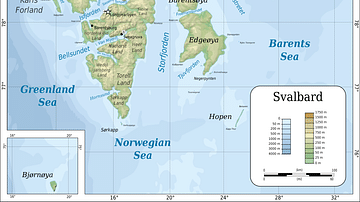
A History of Svalbard
Svalbard is an archipelago in the Arctic Ocean on the northwest corner of the Barents Shelf. It is 800 kilometres (497 mi) north of mainland Norway and sits roughly midway between the top of Norway and the North Pole. It is bordered by Greenland...

Definition
Mauryan Empire
The Mauryan Empire (322 BCE - 185 BCE) supplanted the earlier Magadha Kingdom to assume power over large tracts of eastern and northern India. At its height, the empire stretched over parts of modern Iran and almost the entire Indian subcontinent...

Definition
Batu Khan
Batu Khan (l. 1205-1255 CE) was a grandson of Genghis Khan and the founder of the Golden Horde. Batu was a skilled Mongol military commander and won battles from China to Persia, although his most famous exploits involve the grand Mongol...

Image
Russian Tsar Peter I
Portrait of Russian Tsar Peter I the Great by Godfrey Kneller, painted between 11 January and 21 April 1698, when Peter the Great was in London visiting William III of England. The Royal Collection. The portrait was Peter's gift to William...
