
Search
Remove Ads
Advertisement
Search Results

Definition
Apsaras and Gandharvas
In the Vedas, the apsaras are water nymphs, often married to the gandharvas. By the time the Puranas and the two epics were composed, the apsaras and gandharvas had become performing artists to the gods; the apsaras are singers, dancers...

Definition
Hinduism
Hinduism is the oldest religion in the world, originating in Central Asia and the Indus Valley, still practiced in the present day. The term Hinduism is what is known as an exonym (a name given by others to a people, place, or concept) and...

Definition
Brahmanism
Brahmanism (also known as Vedic Religion) is the belief system that developed from the Vedas during the Late Vedic Period (c. 1100-500 BCE) originating in the Indus Valley Civilization after the Indo-Aryan Migration c. 2000-1500 BCE. It claims...

Definition
Script - The Written Record of Humanity
Script is the written expression of a language. Cuneiform, the first script, was invented in Sumer, Mesopotamia, circa 3600/3500 BCE; hieroglyphics sometime prior to the Early Dynastic Period in Egypt (circa 3150-2613 BCE); and Sanskrit in...

Definition
Tara
Tara is a female deity in both Hinduism and Buddhism who personifies compassion and offers salvation from the suffering of rebirth and death. She is thought to have been born of empathy for the suffering world and is regularly invoked for...
Definition
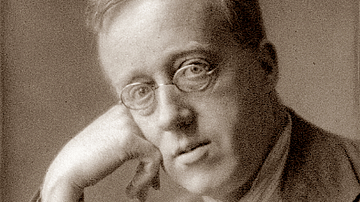
Gustav Holst
Gustav Holst (1874-1934) was a British composer of Swedish origin most famous for his dramatic orchestral suite The Planets, first performed in public in 1919. Holst also composed several operas, wrote sacred choral works such as The Hymn...

Image
The Four Castes of Ancient India - The Varna System
This infographic illustrates the Varna caste system in ancient India. First mentioned in the Rig Veda's Purusha Sukta c. 1200–1000 BCE, it shows society divided into four groups that emerged from the sacrifice of Purusha, a transcendent and...

Video
Introduction to the Vedas: the Religious Texts from Ancient India
The Vedas are religious texts from Ancient India that inform the religion of Hinduism. The religion of Hinduism is known by adherents as Sanatan Dharma which means “eternal order” and the Vedas are thought to be the literal words of God which...

Article
Caste System in Ancient India - Varna Ideals in Vedic Times
Ancient India in the Vedic Period (c. 1500-1000 BCE) did not have social stratification based on socio-economic indicators; rather, citizens were classified according to their Varna or castes. 'Varna' can literally mean 'colour' but in ancient...

Definition
Magadha Kingdom
Magadha was an ancient kingdom located on the Indo-Gangetic plains in eastern India and spread over what is today the modern state of Bihar. At the height of its power, it claimed suzerainty over the entire eastern part of the country (roughly...
