
Search
Remove Ads
Advertisement
Search Results

Definition
Argead Dynasty
The Argead dynasty, the ancient Macedonian house of Dorian Greek origin, lasted from the 7th century to 310 BCE. The mythological founder of the dynasty was King Caranus but it was under Philip II of Macedon (382-226 BCE) that...

Definition
Gracchi Brothers
Tiberius Sempronius Gracchus (c. 163-133 BCE) and his younger brother Gaius (c. 154-121 BCE) were tribunes of the plebs in the Roman Republic. Serving in 133 BCE, Tiberius introduced a land reform but was beaten to death after...

Definition
Helen of Troy
Helen of Troy (sometimes called Helen of Sparta) is a figure from Greek mythology whose elopement with (or abduction by) the Trojan prince Paris sparked off the Trojan War. Helen was the wife of Menelaus, the king of Sparta, and...

Definition
Ovid
Publius Ovidius Naso, more commonly known to history as Ovid (43 BCE - 17 CE), was one of the most prolific writers of the early Roman Empire. His works of poetry, mostly written in the form of elegiac couplets, influenced many of the...

Definition
Hetaira
A hetaira (pl. hetairai) was an educated female prostitute in ancient Greece and a common participant in symposia or drinking parties in private homes. Sometimes referred to in English as a courtesan, the Greek term hetaira was a euphemism...
Article
The Eloquent Peasant & Egyptian Justice
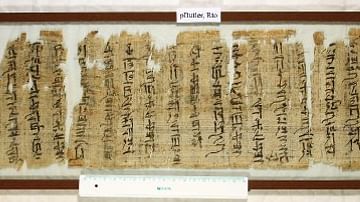
The Tale of the Eloquent Peasant is a literary work from the Middle Kingdom of Egypt (2040-1782 BCE) which illustrates the value society placed on the concept of justice and equality under the law. In the story...

Article
Protagoras's Paradox
The sophists in ancient Greece were a class of teachers who, for a fairly high fee, would instruct the affluent youth in politics, history, science, law, mathematics and rhetoric as well as the finer points of grammar and...

Article
Gracchus Babeuf & the Conspiracy of Equals
On 10 May 1796, in the later stages of the French Revolution (1789-1799), a group of leftwing agitators were arrested in Paris, charged with plotting to overthrow the French Directory. After a series of trials...

Article
Marcus Aurelius: Philosopher Emperor or Philosopher-King?
Co-authored by Steven Umbrello and Tina Forsee It is very common to hear in both academic circles, as well as more close-knit Stoic circles, Marcus Aurelius (121 – 180 CE) being referred to...

Article
Saint Augustine of Hippo & His Confession of Faith
Few theologians have attained as much renown and influence in history as Saint Augustine of Hippo (354-430 CE), a 'Doctor' of the Catholic Church and simply known by his peers as 'The Knowledgeable...
