
Search
Search Results
Definition
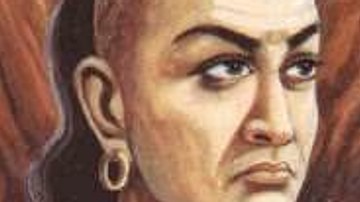
Chanakya
Chanakya (l. c. 350-275 BCE, also known as Kautilya and Vishnugupta) was prime minister under the reign of Chandragupta Maurya (r. c. 321-c.297 BCE), founder of the Mauryan Empire (322-185 BCE). He is best known as the author of the political...

Definition
Sogdiana
Sogdiana (or Sogdia) is a region in Central Asia between the mighty rivers Iaxartes in the north and Oxus in the south. Its eastern and western limits are more difficult to determine, especially since the toponym Sogdiana covered different...
Definition
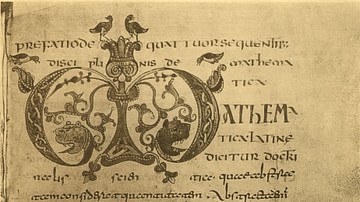
Etymologiae
The Etymologiae (Etymologies) is a Latin work by Isidore of Seville (l. c. 560 - 636 CE), compiled in the early 7th century CE and published in its final form shortly after his death. The book is a type of medieval encyclopedia and is a survey...

Image
Late Medieval Portrait of Epictetus
A detail from an illustration of the Stoic philosopher Epictetus (c. 50 CE- c. 130 CE) as imagined in a 15th Century CE scientific manuscript. The manuscript recounts an anachronistic discussion between the Roman emperor Hadrian (r. 117 -...
Article
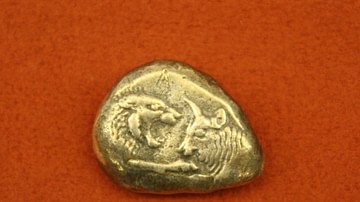
The Importance of the Lydian Stater as the World's First Coin
The Lydian Stater was the official coin of the Lydian Empire, introduced before the kingdom fell to the Persian Empire. The earliest staters are believed to date to around the second half of the 7th century BCE, during the reign of King Alyattes...

Article
Kingdom of Magadha: Wars and Warfare
In ancient India from the 6th century BCE onwards, the kingdom of Magadha (6th century BCE to 4th century BCE) made a mark for itself. Located in the eastern part of India in what is today the state of Bihar, it outshone other kingdoms and...

Article
Siege Warfare in Ancient India
Forts and sieges held a key position in ancient Indian warfare. Built on considerations of strategic location, topography, and the natural advantages provided by the site, forts would be heavily supplemented with man-made fortifications...

Article
The Hypaspists in Ancient Sources
Hypaspist translitterates the Greek term meaning shield-bearer, or armour-bearer (ὁ ὑπασπιστής). This noun is formed from the verb ὑπασπίζειν - to carry the shield for another; serve as a shieldbearer. The Shieldbearers of the Argead kings...

Definition
Nero - The Artist Emperor
Nero (37-68 CE) was the fifth Roman emperor, who reigned from 54 to 68 CE. The last emperor of the Julio-Claudian Dynasty, he came to power at the age of 16 with the help of his mother, Agrippina the Younger. Initially a popular ruler, his...

Definition
William the Conqueror
William the Conqueror (c. 1027-1087), also known as William, Duke of Normandy, led the Norman Conquest of England in 1066 when he defeated and killed his rival Harold Godwinson at the Battle of Hastings. Crowned King William I of England...
