
Search
Did you mean: Ptolemy I?
Remove Ads
Advertisement
Search Results

Article
Alexander the Great & the Burning of Persepolis
In the year 330 BCE Alexander the Great (l. 356-323 BCE) conquered the Achaemenid Persian Empire following his victory over the Persian Emperor Darius III (r. 336-330 BCE) at the Battle of Gaugamela in 331 BCE. After Darius III's defeat...

Lesson
Ptolemaic Dynasty in Ancient Egypt
We have prepared one lesson plan including classroom activities, assignments, homework, and keys as well as: - Open questions adaptable for debates, presentations, and essays - Recommended resources to provide you and your students with...

Definition
Galileo Galilei
Galileo Galilei (1564-1642) was an Italian mathematician, physicist, astronomer, and natural philosopher. He created a superior telescope with which he made new observations of the night sky, notably that the surface of the Moon has mountains...

Definition
Cleopatra Selene II
Cleopatra Selene II (40 - c. 5 BCE) was a member of the Ptolemaic Dynasty who became the queen of Mauretania upon her marriage to King Juba II of Numidia (48 BCE - 23 CE). Though more obscure than her famous mother, Cleopatra VII (69-30 BCE...

Definition
Fayum
The Faiyum (also given as Fayoum, Fayum, and Faiyum Oasis) was a region of ancient Egypt known for its fertility and the abundance of plant and animal life. Located 62 miles (100 kilometers) south of Memphis (modern Cairo), the Faiyum was...

Article
Cultural Links between India & the Greco-Roman World
Cyrus the Great (558-530 BCE) built the first universal empire, stretching from Greece to the Indus River. This was the famous Achaemenid Empire of Persia. An inscription at Naqsh-i-Rustam, the tomb of his able successor Darius I (521-486...

Article
Was Cleopatra Beautiful?
The idea that Cleopatra VII (69-30 BCE), the famous last queen of ancient Egypt, owed her powerful position to her beauty persists. “The nose of Cleopatra: if it had been shorter, the whole face of the earth would have changed,” the French...

Article
The Masaesyli and Massylii of Numidia
The North African Berber kingdom of Numidia (202-40 BCE) was originally inhabited by a tribe (or federation of tribes) known as the Masaesyli, to the west, and a coalition of smaller tribes, known as the Massylii, to the east. The meaning...
Article
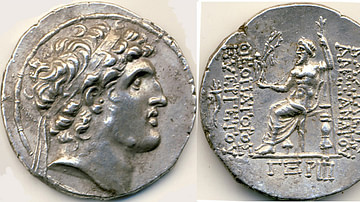
Alexandros I Balas
Alexandros I Balas was a Seleucid king from 152 BC to 145 BCE. As the Seleucid king Demetrius I Soter (162-150 BCE) became more and more unpopular due to his arrogance and drunkenness, it was quite an easy task for the rival kingdoms, such...

Definition
Alexander the Great
Alexander III of Macedon, better known as Alexander the Great (l. 21 July 356 BCE – 10 or 11 June 323 BCE, r. 336-323 BCE), was the son of King Philip II of Macedon (r. 359-336 BCE) who became king upon his father's death in 336 BCE and then...
