
Search
Did you mean: Sutra?
Remove Ads
Advertisement
Search Results

Article
Legions of Mesopotamia, Cappadocia, & Arabia
As the Roman Empire expanded further eastward, annexing territories that were once the domain of the Parthians, the legions of Mesopotamia, Cappadocia, and Arabia were called upon to safeguard these newly...

Article
The AlUla World Archaeology Symposium 2024 - Three Days of Learning and Sharing Amongst Archaeologists
I was recently invited to an archaeological symposium at the site of AlUla in Saudi Arabia. I had known about AlUla since 2018 and seen photographs of the amazing...

Image
Map of the Roman Rule in the Levant, c. 200 CE
The Roman Levant around 200 CE, during the height of imperial consolidation under the Severan dynasty (193 - 235 CE), formed one of the empire’s most dynamic and interconnected frontier regions. Administratively...
Image
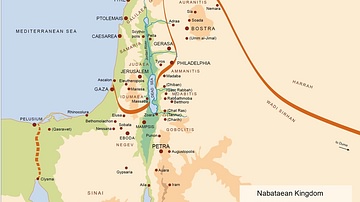
Map of the Nabatean Kingdom
Map of the Nabatean Kingdom at its greatest extent, c. 85 BCE.

Video
The Rise and Fall of the Kingdom of Nabatea
The Nabatean Kingdom was a powerful political entity which flourished in the region of modern-day Jordan between the 4th century BCE and c. 106 CE and is best known today for the ruins of its capital city...

Video
Ancient Persia and the Arabian Peninsula
This video discusses the civilizations of Ancient Persia and the Arabian Peninsula. In this episode, the grand residences at Persepolis and the imperial palaces of Darius are toured. The second half of...

Image
Boundary Marker with an Official Inscription from Chalkidiki
Inscribed stone boundary marker from Chalkidiki, c.350 to 300 BCE. Archaeological Museum of Thessalonika. It is an example of ancient Greek boundary markers, known as horoi, and it contains...

Image
Hegra Tomb
Nabataean tomb at Hegra, photograph by the Royal Commission of AlUla, Saudi Arabia. A Nabataean tomb at the magnificent site of Hegra, AlUla, Saudi Arabia. Hegra was a massive site settled during the Nabatean and Roman times. A UNESCO...
Image
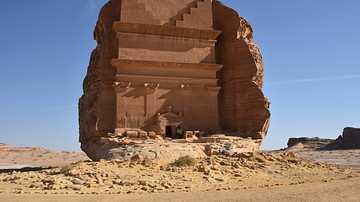
Tomb of the Lion of Kuza, Hegra
The Tomb of the Lion of Kuza (Qasr al-Farid) is a 1st-century CE Nabatean unfinished tomb carved into a single huge rock in Hegra (Madain Saleh) in Saudi Arabia, the Kingdom of Nabatea's second capital after Petra...
Image
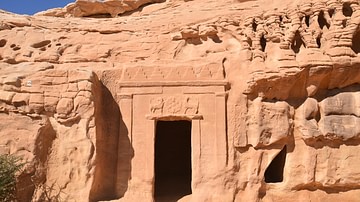
The Lion Tomb, Hegra
The Lion Tomb is located in the Qasr al-Bint Nabataean Necropolis of Hegra (now in Saudi Arabia). The façade of the tomb is decorated with a carving of two felines on either side of a rosette. The name of the stonemason who...
