
Search
Did you mean: Norns?
Remove Ads
Advertisement
Search Results

Definition
Byzantine Empire
The Byzantine Empire existed from 330 to 1453. It is often called the Eastern Roman Empire or simply Byzantium. The Byzantine capital was founded at Constantinople by Constantine I (r. 306-337). The Byzantine Empire varied in...

Definition
Rollo of Normandy
Rollo (l. c.860-c.930 CE, r. 911-927 CE) was a Viking chieftain who became the founder and first ruler of the region of Normandy. He converted to Christianity as part of a deal with the Frankish king Charles the Simple (893-923...
Definition
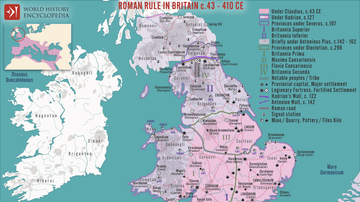
Ancient Britain
Ancient Britain was a landmass on the northwest of the continent of Europe first occupied by humans c. 800,000 years ago prior to it becoming an island c. 6000 BCE due to flooding which separated it from the mainland. Agriculture...

Definition
Mont-Saint-Michel
Mont-Saint-Michel is the name of a tidal island located off the coasts of Normandy and Brittany, near the mouths of the Couesnon River and the town of Avranches in France. While the island of Mont-Saint-Michel has held cultural...

Definition
Odo of Bayeux
Odo of Bayeux (d. 1097 CE) was the bishop of Bayeux in Normandy and half-brother of William the Conqueror (r. 1066-1087 CE). After the Norman conquest of England in 1066 CE, Odo was given vast Anglo-Saxon estates and made, as the...

Definition
John II Komnenos
John II Komnenos “the Handsome” was emperor of the Byzantine Empire from 1118 CE to 1143 CE. John, almost constantly on campaign throughout his reign, would continue the military successes of his father Alexios I with significant...
Article
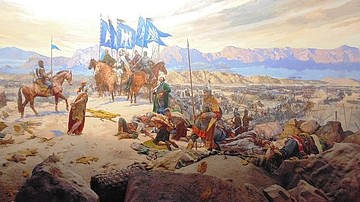
Battle of Manzikert
The Battle of Manzikert (Mantzikert) in ancient Armenia in August 1071 CE was one of the greatest defeats suffered by the Byzantine Empire. The victorious Seljuk army captured the Byzantine emperor Romanos IV Diogenes, and...

Article
William the Conqueror's Harrying of the North
By the end of 1066 CE William the Conqueror had won a decisive victory at the Battle of Hastings, subdued the south-east of England and been crowned King William I in Westminster Abbey but there remained...

Image
The Bayeux Tapestry in 12 Scenes - Conquest, Propaganda, and the Norman Claim to England, 1066
The Bayeux Tapestry, created in the late 11th century, probably in England for a Norman patron, is one of the most important surviving visual sources for the Norman...

Image
Map of the Norman World, c. 1130 - From Viking Settlers to a Trans-Mediterranean Networks
The Norman world (c. 10th–13th centuries CE) was not a single unified empire, but a far-reaching network of Norman-ruled principalities, kingdoms, military expeditions...
