
Search
Remove Ads
Advertisement
Search Results

Video
Why Did the Dutch Give Up New York?
New York is one of the most influential cities in the world; economically, culturally and diplomatically it is a powerhouse. It’s population also largely speaks English, a legacy America has from it’s past as a...

Definition
Fenrir
Fenrir is the great wolf in Norse Mythology who breaks free from his chains at Ragnarök, the twilight of the gods, kills Odin, and is then killed by Odin’s son Vidarr. Fenrir is the son of the trickster god Loki and brother of the World...

Definition
New Model Army
The New Model Army was created in February 1645 by the Parliamentarians during the English Civil Wars (1642-1651) that turned England from a monarchy to a republic. It was a professional army in terms of its personnel, training...

Definition
The Conquest of New Spain
The Conquest of New Spain by Bernal Díaz del Castillo (1492 to c. 1580) is an account written in 1568 of the early Spanish colonization of Mesoamerica, specifically the conquest of the Aztec civilization in Mexico from...

Article
Traditional Maori Tattoo of New Zealand
Te Papa Tongawera (or simply Te Papa) is New Zealand's innovative national museum situated near the foreshore of beautiful Wellington harbour. Te Papa Tongawera means “container of treasures” in Te Reo Maori...

Article
The French Exploration of New Zealand
The French exploration of New Zealand has been overshadowed by the achievements of British navigator Captain James Cook (1728-1779), but French navigators who visited Aotearoa's (New Zealand) shores named over...

Video
New York Kouros, c. 590–580 BCE
Marble Statue of a Kouros (New York Kouros), c. 590–580 BCE (Attic, archaic), Naxian marble, 194.6 x 51.6 cm (The Metropolitan Museum of Art)
Speakers: Dr. Beth Harris and Dr. Steven Zucker
Image
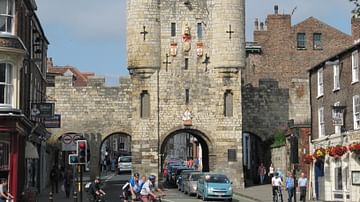
Micklegate Bar, York
Micklegate Bar, York, one of the medieval gates of the city. The gate was first built in the 12th century CE and then extended upwards in the 14th century CE.

Article
Battle of New Orleans - The American Agincourt
The Battle of New Orleans (8 January 1815) was the final major battle of the War of 1812, in which a ragtag American army under Major General Andrew Jackson (1767-1845) beat back a superior British force...

Image
Arms of Richard, Duke of York
The arms of Richard, Duke of York (l. 1411-1460 CE). Richard, the 3rd Duke of York, was a great-grandson of Edward III of England (r. 1327-1377 CE), hence his use of the royal arms (lions and fleur-de-lis).
