
Search
Did you mean: Nergal?
Remove Ads
Advertisement
Search Results

Video
Lumbini - The Birth Place of Gautam Buddha
Lumbinī is a Buddhist pilgrimage site in the Rupandehi district of Nepal. It is the place where Queen Mayadevi gave birth to Gautam Buddha. Lumbini has a number of temples, including the Mayadevi temple, and others. Also located here is the...

Definition
Indus Valley Civilization
The Indus Valley Civilization was a cultural and political entity which flourished in the northern region of the Indian subcontinent between c. 7000 - c. 600 BCE. Its modern name derives from its location in the valley of the Indus River...

Definition
Ancient India
India is a country in South Asia whose name comes from the Indus River. The name 'Bharata' is used as a designation for the country in their constitution referencing the ancient mythological emperor, Bharata, whose story is told, in part...

Definition
Siddhartha Gautama
Siddhartha Gautama (better known as the Buddha, l. c. 563 - c. 483 BCE) was, according to legend, a Hindu prince who renounced his position and wealth to seek enlightenment as a spiritual ascetic, attained his goal and, in preaching his path...

Definition
Buddhism
Buddhism is a non-theistic religion (no belief in a creator god), also considered a philosophy and a moral discipline, originating in the region of modern-day India in the 6th and 5th centuries BCE. It was founded by the sage Siddhartha Gautama...

Definition
Sepoy Mutiny
The 1857-8 Sepoy Mutiny (aka Sepoy Rebellion, Indian Mutiny, The Uprising or First Indian War of Independence) was a failed rebellion against the rule of the British East India Company (EIC) in India. Initially a mutiny of the Indian soldiers...
Definition
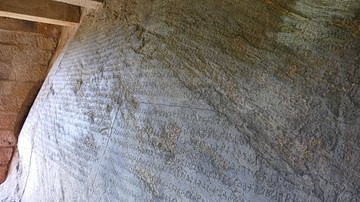
The Edicts of Ashoka the Great
The Edicts of Ashoka are 33 inscriptions engraved on pillars, large stones, and cave walls by Ashoka the Great (r. 268-232 BCE), the third king of the Mauryan Empire (322-185 BCE) of India. One set, the so-called Major Rock Edicts, are consistent...

Definition
Chandragupta Maurya
Chandragupta Maurya (c. 321 - c. 297 BCE), known as Sandrakottos (or Sandrokottos) to the Greeks, was the founder of the Maurya Dynasty (4th-2nd century BCE) and is credited with the setting up of the first (nearly) pan-Indian empire. Aided...

Definition
Indian Princely States
The Indian Princely states (aka Native States or Princely India) were those states in the Indian subcontinent the British did not conquer but which were typically bound by treaty first to the East India Company and then to the British Crown...

Definition
Ajatashatru
Ajatashatru (c. 493/492 BCE - c. 462/460 BCE) was the second important king of the Haryanka Dynasty, who came to the throne of Magadha by deposing and executing his own father Bimbisara. The Haryanka Dynasty (c. 545/544 BCE - c. 413 BCE...
