
Search
Remove Ads
Advertisement

 This answer was generated by
 Search Results

Definition
Late Period of Ancient Egypt - The End of Egyptian Rule of Egypt
The Late Period of Egypt (525-332 BCE) is the era following the Third Intermediate Period (1069-525) and preceding the brief Hellenistic period (332-323 BCE) when Egypt was ruled by the Argead...

Image
Sarcophus of Nectanebo II
The sarcophagus was prepared for Egypt's last native pharaoh, Nectanebo II. Nectanebo's reign was cut short in the year 343 BCE, when the emperor Artaxerxes III restored Egypt to Persian rule. Nectanebo fled south, never...

Image
Obelisk of Nectanebo II
According to the vertical inscription of this black siltstone obelisk (1.74 meter in height), Nectanebo set up this obelisk (and its fellow obelisk ) at the doorway of the sanctuary of Thoth, the Twice-Great, Lord of Hermopolis...
Image
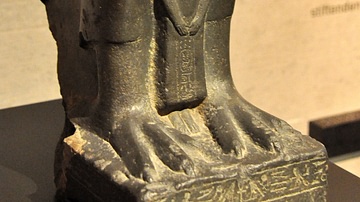
Horus & Nectanebo II
In this greywacke statue, the god Horus (depicted as a falcon; head is lost) protects the praying figure of Nectanebo II. From Memphis, Egypt. 30th Dynasty, circa 350 BCE. (State Museum of Egyptian Art, Munich, Germany).
Image
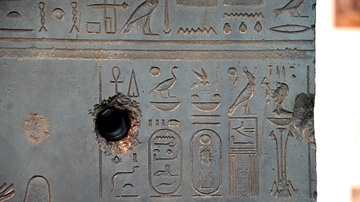
Detail of the Screen Slab of King Nectanebo I
This detail shows the cobra goddess Wadjyt empowering king Nectanebo I, who is represented by his Horus name and cartouches. A pharaoh had five official names; this panel, shows the most important three...
Image
Head of King Nectanebo I or II
This head was part of a statue which was placed in a temple. No inscription survives to identify the king, but stylistic details point to Nectanebo I or II, the principal kings of Egypt's last native Dynasty. The king's...
Image
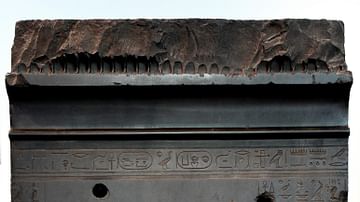
Screen Slab of King Nectanebo I
This slab enclosed a sacred spot in the temple of Atum, a creator god, Heliopolis. King Nectanebo I is shown kneeling and making offerings. In this scene, he presents a loaf of bread. On the other side (now damaged...

Definition
Artaxerxes II
Artaxerxes II (r. 404-358 BCE, also known as Artaxerxes II Mnemon) was the 10th monarch of the Achaemenid Empire (c. 550-330 BCE). He was the son of Darius II (r. 424-404 BCE) and Parysatis (who was Darius II's half-sister) and...

Definition
Karnak
Karnak is the modern-day name for the ancient site of the Temple of Amun at Thebes, Egypt. The Egyptians called the site Nesut-Towi, "Throne of the Two Lands", Ipet-Iset, "The Finest of Seats" as well as Ipt-Swt, "Selected Spot" also...
Image
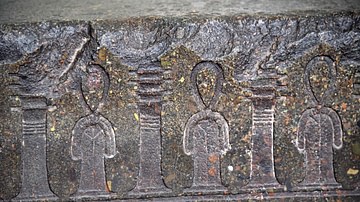
Djed & Tyet
Detail of the upper margin of the sarcophagus of the last native Egyptian pharaoh Nectanebo II showing the so-called "djed" and tyet" symbols. The djed, a pillar-like symbol, represents the backbone (spine) of Osiris, the god of the...
