
Search
Remove Ads
Advertisement
Search Results

Definition
Adam Smith
Adam Smith (1723-1790) was a Scottish philosopher, economist, and leading Enlightenment figure. In The Wealth of Nations, he advocates free trade and limited interference in markets by governments, for which he is seen as the founder...

Definition
Antisthenes of Athens
Antisthenes of Athens (l. c. 445-365 BCE) was a Greek philosopher who founded the Cynic School. He was a follower of Socrates and appears in Plato's Phaedo as one of those present at Socrates' death. He is also one of the...

Definition
Philolaus
Philolaus (l. c. 470 to c. 385 BCE) was a Pythagorean philosopher who claimed that fire was the first cause of existence and heat the underlying source of human life. He is best known for his pyrocentric model of the universe, which...

Definition
Western Astrology
Western astrology refers to a form of divination based on the motion of astronomical objects such as stars or planets. The belief that astronomical objects are divine or influence events on Earth is found in many cultures, but...

Definition
The Enlightenment
The Enlightenment (Age of Reason) was a revolution in thought in Europe and North America from the late 17th century to the late 18th century. The Enlightenment involved new approaches in philosophy, science, and politics. Above...

Definition
John Locke
John Locke (1632-1704) was an English philosopher responsible for laying the foundation of the European Enlightenment. Locke believed that each branch of government should have separate powers, that liberty must be protected from...

Article
The Life of Diogenes of Sinope in Diogenes Laertius
Diogenes of Sinope (c. 404-323 BCE) was a Greek Cynic philosopher best known for holding a lantern to the faces of the citizens of Athens claiming he was searching for an honest man. He was most likely...

Definition
Thomas Hobbes
Thomas Hobbes (1588-1679) was an English philosopher who famously summarised his pessimistic view of human nature in his greatest work, Leviathan, published in 1651. Hobbes believed that the life of humanity in the state of nature...
Definition
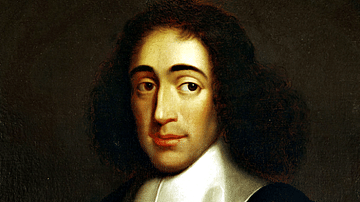
Baruch Spinoza
Baruch Spinoza (1632-1677) was a Dutch philosopher who combined rationalism and metaphysics to create a unique system of thought. Spinoza was held up as an atheist philosopher in the 18th century, but this is not an entirely accurate...

Article
Roman Students in Athens
Training in oratory was a crucial part of Roman education; it was associated with a young boy's transition into adult life. As Athens was considered the intellectual centre of the eastern Mediterranean, many students undertook...
