
Search
Remove Ads
Advertisement
Search Results
Image
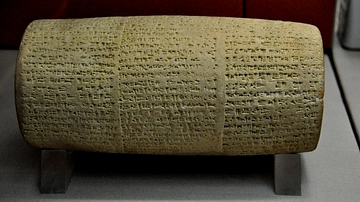
Terracotta Cylinder of King Nabonidus
This cylinder includes three columns of cuneiform inscriptions that record the reconstruction and restoration of the temple of Shamash, the sun God, at Larsa, by the last king of Babylon, Nabonidus. Probably from...

Article
The Cyrus Cylinder
The Cyrus Cylinder is a document issued by Cyrus the Great, consisting of a cylinder of clay inscribed in Akkadian cuneiform script. The cylinder was created in 539 BCE, surely by order of Cyrus the Great, when he took Babylon...

Definition
Nanna - Mesopotamian God of the Moon and Wisdom
Nanna (also known as Nannar, Nanna-Suen, Sin, Asimbabbar, Namrasit, Inbu) is the Mesopotamian god of the moon and wisdom. He is one of the oldest gods in the Mesopotamian pantheon and is first mentioned...

Definition
Ziggurat - Mountains of the Gods
A ziggurat is a form of monumental architecture originating in ancient Mesopotamia, which usually had a rectangular base and was built in a series of steps up to a flat platform upon which a temple was raised. The...

Definition
Achaemenid Empire
East of the Zagros Mountains, a high plateau stretches off towards India. While Egypt was rising up against the Hyksos, a wave of pastoral tribes from north of the Caspian Sea was drifting down into this area and across into...

Definition
Medes
The Medes or Medians were a group of Indo-Iranian-speaking people from central Asia who migrated westwards and entered northern Iran around the end of the 2nd millennium BCE. They settled in the highlands of Zagros (Zagreus in Greek...

Image
Mesopotamian Tablet Naming Belshazzar
This adminsitrative document is dated to the "24th day of Kislimu in the 11th year Nabonidus, King of Babylon". It mentions "a slave of Bel-sharra-usur (Belshazzar),son of the king". Although Belshazzar is acting...

Article
The Rock-Cut Tombs of Qizqapan, Iraqi Kurdistan: Median or Achaemenid?
O Creator of the material world, at what distance from the holy man (should the place for the dead body be)?" Ahura Mazda replied: "Three paces from the holy man". (Vend. 8. 6-7) In...

Article
Greco-Bactrian and Indo-Greek Kingdoms in Ancient Texts
The rarity of the appearance of Greco-Bactrian and Indo-Greek kingdoms in ancient literature is one of the reasons why those states are so little-known today. Indo-Greek literature did exist, but...

Article
Some new hypotheses on the problems of the Indo-Greek kingdoms
Warning: See the definitions of Greco-Bactrian and Indo-Greek Kingdoms before reading this article, otherwise the following lines could give you serious headaches! A lack of information is...
