
Search
Remove Ads
Advertisement
Search Results

Definition
Kingdom of Abyssinia
The Kingdom of Abyssinia was founded in the 13th century CE and, transforming itself into the Ethiopian Empire via a series of military conquests, lasted until the 20th century CE. It was established by the kings of the Solomonid...
Definition
Hussite Wars
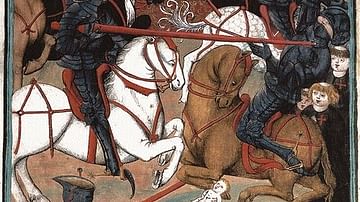
The Hussite Wars (1419 to c. 1434) were a series of conflicts fought in Bohemia (modern-day Czech Republic) between followers of the reformer Jan Hus and Catholic loyalists toward the end of the Bohemian Reformation (c. 1380 to c...

Definition
Aztec Art
The Aztec culture, centred at the capital of Tenochtitlan, dominated most of Mesoamerica in the 15th-16th centuries. With military conquest and trade expansion, the art of the Aztecs also spread, helping the Aztec civilization achieve...

Definition
Teotihuacan
Teotihuacan, located in the Basin of Central Mexico, was the largest, most influential, and most revered city in the history of the New World. It flourished in Mesoamerica's Golden Age, the Classic Period of the first millennium CE...

Definition
Hatti
The Hatti were an aboriginal people in central Anatolia (present-day Turkey) who first appeared in the area around the River Kizil Irmak. The prevailing understanding is that they were native to the land although it has been suggested...

Definition
Byzantine Empire
The Byzantine Empire existed from 330 to 1453. It is often called the Eastern Roman Empire or simply Byzantium. The Byzantine capital was founded at Constantinople by Constantine I (r. 306-337). The Byzantine Empire varied in...

Definition
Timbuktu - West Africa's Great Trading Centre
Timbuktu (Timbuctoo) is a city in Mali, West Africa which was an important trade centre of the Mali Empire which flourished between the 13th and 15th centuries. The city, founded c. 1100, gained wealth from...

Definition
Renaissance Humanism
Renaissance Humanism was an intellectual movement typified by a revived interest in the classical world and studies which focussed not on religion but on what it is to be human. Its origins went back to 14th-century Italy...
Definition
Pindar
Pindar (c. 518 to c. 448/7 BCE) was an ancient Greek lyric poet, probably the greatest of his time. His works have been divided into 17 books of different types of poetry, but only those containing 44 choral victory songs composed for...

Definition
Portuguese Nagasaki
Nagasaki, on the northwest coast of Japan’s Kyushu Island, was an important Portuguese trading base from c. 1571 to 1639, and the most eastern outpost of the Portuguese empire. The Portuguese presence transformed Nagasaki from...
