
Search
Did you mean: Inca Religion?
Remove Ads
Advertisement
Search Results

Image
Minoan Bull Leaping
A fresco showing bull leaping, Minoan Knossos (Final Palatial period 1450-1400 BCE), Heraklion Archaeological Museum, Crete.

Image
Minoan Bee Pendant
A solid gold Minoan pendant depicting two bees clutching a honeycomb, Old Palace cemetery at Chrysolakkos near Malia, Crete, 1800-1700 BCE.
Herakleion Archaeological Museum, Crete.

Image
Minoan Rhyton
Stone rhyton (libation vase) in the form of a bull's head from the Minoan site of Knossos, New-Palace period (1600-1500 BCE), Heraklion Archaeological Museum, Crete.
Image
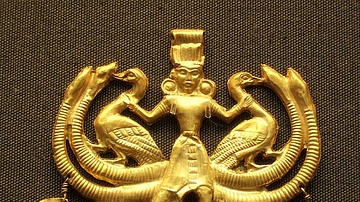
Minoan 'Master of the Animals' Pendant
A solid gold pendant from the Minoan civilization depicting a deity holding two birds, possibly geese (18-17th century BC). Provenance: Aegina (British Museum, London)
Image
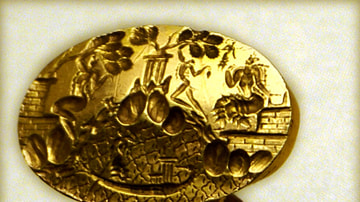
Minoan Gold Ring
An engraved gold ring from the Minoan civilization on Crete, 15-14th century BCE. The ring probably originates from Knossos and depicts the epiphany of a goddess: seated in a shrine, floating in the air and standing in a boat. The hoop is...
Image
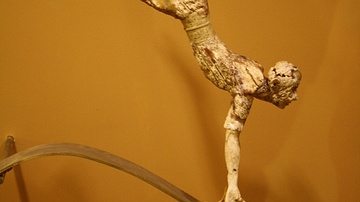
Minoan Bull-Leaper
An ivory figurine representating a bull-leaper from a three dimensional composition (with two other figures and a bull) depicting this Minoan sporting or religious activity. Hair would have been added using bronze wire and clothes in gold...

Definition
Mycenaean Civilization
The Mycenaean civilization flourished in the Late Bronze Age (c. 1700-1100 BCE), peaking from the 15th to the 13th century BCE. The Mycenaeans extended their influence throughout the Peloponnese in Greece and across the Aegean from Crete...

Image
Minoan Bronze Shield
Bronze shield, Crete, Geometric period, 8th-7th century BCE. Heraklion Archaeological Museum, Crete. The bronze tympanon/shield found in the Idaean Cave is a votive offering from around the 8th century BCE. It is decorated with a bas-relief...

Collection
Maya Religion & Culture
Maya religion and culture is among the most advanced and sophisticated of the Pre-Colombian Americas as evidenced by the ruins of their great cities and what remains of their writings after most were burned by the Spanish in 1562. The Maya...

Collection
Ancient Egypt: Government & Religion
Government and religion in ancient Egypt were fully integrated beginning with the First Dynasty of Egypt (c. 3150 to c. 2890 BCE). The king was understood as a representative of a god, the specific deity sometimes changing with different...
