
Search
Did you mean: Inca Religion?
Remove Ads
Advertisement
Search Results

Image
Minoan Double Axes
Gold votive double axes, New Palace period (1600-1450 BCE), Heraklion Archaeological Museum, Crete.
The double axe, also known as 'labrys', may be the origin of the labyrinth myth of Knossos.

Definition
Zakros
Ideally situated in a sheltered gulf surrounded by mountains, Zakros (or Kato Zakros) in south-eastern Crete, was the fourth largest Minoan settlement after Knossos, Phaistos and Malia. The ancient name has been lost and the present one derives...

Image
Minoan Religious Procession on Hagia Triada Sarcophagus
Minoan limestone sarcophagus, c. 1400 BCE. Heraklion Archaeological Museum, Crete. This painting appears on one of the two longer sides of the sarcophagus. It shows a sacrificial procession, part of a funerary ritual, with a woman offering...

Image
Minoan Octopus
A Minoan octopus, detail from a New-Palace period (1500-1450 BCE) Cretan Clay askos with 'Marine Style' decoration, (Heraklion Archaeological Museum, Crete)
Image
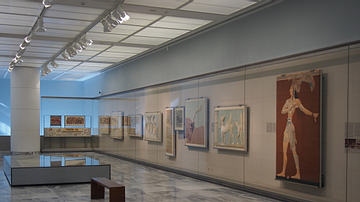
Rooms of Minoan Frescoes, Heraklion Archaeological Museum
The rooms of Minoan frescoes, Archaeological Museum of Heraklion. At the right end is the fresco of the Prince with the Lilies.
Image
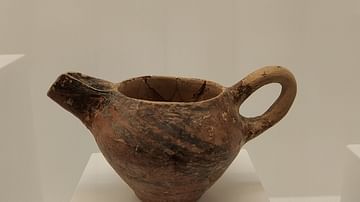
Minoan One-Handled Spouted Bowl
The vase bears a black-painted linear decoration. Middle Minoan I Period (2100-1800 BCE). Made from clay. (Hellenic Museum, Melbourne, Victoria).
Image
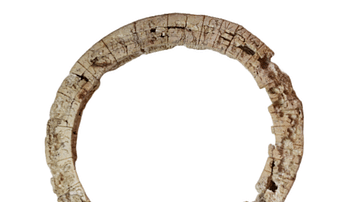
Minoan Ivory Sceptre Covered with Two Linear A Inscriptions
The Minoan ivory scepter discovered in Crete in 2024 is engraved with the longest Linear A inscription ever found. The inscription consists of approximately 119 signs covering the entire surface of the circular head and both sides of the...

Definition
Ancient Greek Dance
In ancient Greece, dance had a significant presence in everyday life. The Greeks not only danced on many different occasions, but they also recognized several non-performative activities such as ball-playing or rhythmic physical exercise...

Definition
Malia
Located near a fertile plain in northern Crete and with its own harbour, Malia was one of the major settlements and palaces of the Minoan civilization. Inhabited since Neolithic times (6000 BCE) and with the first evidence of monumental architecture...

Image
Minoan Snake Goddess Figurine
The Snake Goddess is a faience figurine depicting a woman holding a snake in each hand. It was found in the main sanctuary of the Palace of Knossos in Crete and dates back to around 1650-1550 BCE. Heraklion Archaeological Museum.
