
Search
Remove Ads
Advertisement
Search Results

Article
Pizarro & the Fall of the Inca Empire
In 1533 CE the Inca Empire was the largest in the world. It extended across western South America from Quito in the north to Santiago in the south. However, the lack of integration of conquered peoples into that...

Article
The Hymn to Ninkasi, Goddess of Beer - A Praise Song and Ancient Beer Recipe
The Hymn to Ninkasi is at once a song of praise to Ninkasi, the Sumerian goddess of beer, and an ancient recipe for brewing (though this claim has been challenged). Written down...
Image
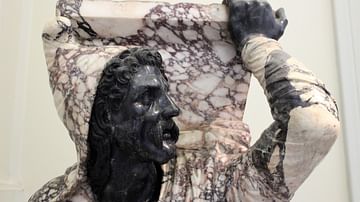
Detail of the Kneeling Barbarian
Detail of the "Kneeling Barbarian", also known as the "Farnese Barbarian". The use of coloured marbles allowed for a polychromatic sculpture without the use of paint or other pigments. Roman sculpture. c. 98-117 CE...

Image
Queen Tiye Bust
Bust of the Egyptian queen Tiye (1398-1338 BCE), wife of the pharaoh Amenhotep III, mother of Akhenaten, and grandmother of both Tutankhamun and Ankhsenamun.
Altes Museum, Berlin.
Image
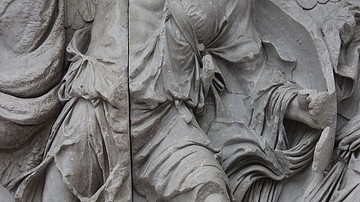
Uranus on the Southern Frieze of the Gigantomachy
Uranus on the southern frieze of the Gigantomachy.
Pergamon Museum, Berlin.

Image
Symposium Scene, Tomb of the Diver
Detail of a painting from the limestone walls of the Tomb of the Diver. The tomb and its artwork is associated with Classical Greek culture which flourished in Magna Graecia during antiquity. From the North Wall...
Image
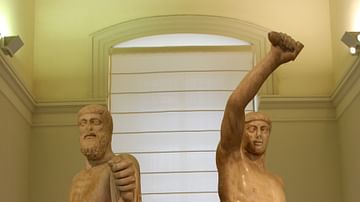
Statue Group of Harmodius & Aristogeiton
Marble statue group depicting the Athenian tyrant-slayers Harmodius and Aristogeiton. These statues are Roman copies of 5th Century BCE Greek originals. (National Archaeological Museum of Naples)
Image
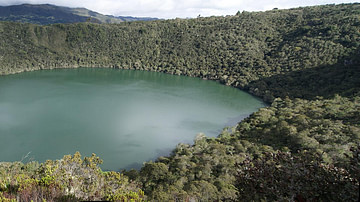
Lake Guatavita, Colombia
Lake Guatavita (Spanish: Laguna de Guatavita), Cundinamarca, Colombia. The site of the Muisca tribe ritual and the birthplace of the myth of El Dorado. One of the most important sites in South America.
Image
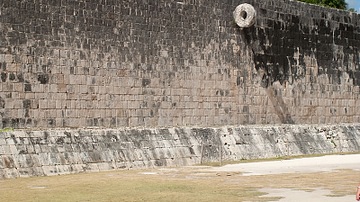
Ball Court Wall & Goal, Chichen Itza
One of the walls and goals of the ball court in the Maya-Toltec city of Chichen Itza. 1050-1200 CE.
Image
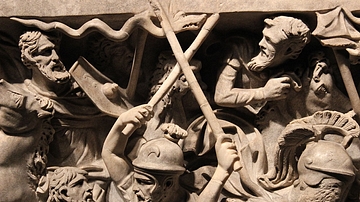
Detail of the Portonaccio Sarcophagus
Detail of the Portonaccio Sarcophagus, which depicts Late Roman legionaries battling barbarians in the 3rd Century BCE. The piece was created between 172-175 CE.
