
Search
Remove Ads
Advertisement
Search Results

Article
The Hymn to Ninkasi, Goddess of Beer - A Praise Song and Ancient Beer Recipe
The Hymn to Ninkasi is at once a song of praise to Ninkasi, the Sumerian goddess of beer, and an ancient recipe for brewing (though this claim has been challenged). Written down circa 1800 BCE, the hymn is no doubt much older, as evidenced...

Article
The Legend of Cutha - A How-To on the Proper Relationship with One's God
The Legend of Cutha (also known as the Cuthean Legend of Naram-Sin, Cutha Legend, and Kutha Legend) is a fictional work dated to the 17th century BCE belonging to the genre known as Mesopotamian naru literature. It features the Akkadian king...

Definition
Ancient Syria
Syria is a country located in the Middle East on the shore of the Mediterranean Sea and bordered, from the north down to the west, by Turkey, Iraq, Jordan, Israel, and Lebanon. It is one of the oldest inhabited regions in the world with archaeological...

Article
Daily Life in Ancient Mesopotamia - Mirroring the Modern World
Daily life in ancient Mesopotamia cannot be described in the same way one would describe life in ancient Rome or Greece. Mesopotamia was never a single, unified civilization, not even under the Akkadian Empire of Sargon of Akkad (the Great...

Definition
Shulgi of Ur - Greatest King of the Ur III Period
Shulgi of Ur (reign 2094 to circa 2046 BCE) is considered the greatest king of the Ur III period in Mesopotamia (circa 2112 to circa 2004 BCE). His father was Ur-Nammu (reign circa 2112-2094 BCE), who founded the Third Dynasty of Ur, and...
Article
Festivals in Ancient Mesopotamia - Courting the Goodwill of the Gods
Festivals in ancient Mesopotamia honored the patron deity of a city-state or the primary god of the city that controlled a region or empire. The earliest, the Akitu festival, was first observed in Sumer in the Early Dynastic period (circa...
Image
Mesopotamian Beer Rations Tablet
The temples issued workers with daily rations of barley beer, the staple drink of Mesopotamia. The tablet was impressed with five different types of numerical symbol. From Mesopotamia, Iraq. Late Uruk Period, 3100-3000 BCE. (The British Museum...

Image
Mesopotamian Record of Barley
On this clay tablet, barley appears 4 times, depicted as a single stalk with ears at the top. Emmer wheat is different from barley, by writing numbers with extra strokes. Three different types of numerical symbol were used. From Mesopotamia...
Image
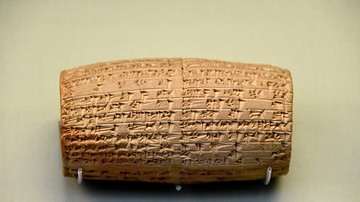
Mesopotamian Cylinder Naming Nabonidus & Sacred Buildings
Clay cylinder with Babylonian characters, recording the restoration of Sin's ziggurat at Ur and also asking him to protect Nabonidus and his son Belshazzar. From Ur, Southern Mesopotamia, modern-day Iraq. Neo-Babylonian Period, reign of Nabonidus...
Image
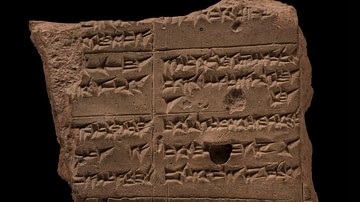
Mesopotamian Tablet with Proverbs
Fragment of a Neo-Assyrian clay tablet, with 8 lines of bilingual text, including proverbs and riddles, from the Library of Ashurbanipal, Kouyunjik, Iraq.
The British Museum, London.
