
Search
Remove Ads
Advertisement
Search Results

Article
Aristotle's On the Heavens
One of Aristotle's more famous quotes was, "All men naturally desire knowledge" ("πάντες ἄνθρωποι τοὺ εἰδέναι ὀρὲγονται φύσει") (Aristotle, Metaphysics, 1.980a.22). As a classical Greek philosopher, an ideology like this...
Article
Exploring Mount Nemrut - A Meeting Point Between East & West
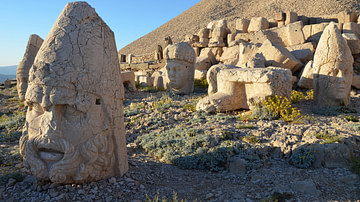
Set within the Anti-Taurus mountain range in southeastern Turkey, beyond the borders of Adiyaman, is the archaeological wonder of Mount Nemrut. Forgotten for centuries, the spellbinding peak...

Article
A Roman Trail in the Moselle Valley
The Moselle Valley is Germany's oldest winegrowing region. The Romans brought viticulture to this area and planted vines along the Moselle River 2000 years ago. After settling the region c. 50 BCE and establishing...
Article
The Life of Aristippus in Diogenes Laertius
Aristippus of Cyrene (l. c. 435-356 BCE) was a hedonistic Greek philosopher who taught that the meaning of life was pleasure and that the pursuit of pleasure, therefore, was the most noble path one could...

Image
10 Women Scientists Who Changed the World - Discoveries That Transformed Science and Medicine
Throughout history, women in science have made groundbreaking discoveries, often pushing the boundaries of knowledge despite being overlooked and underrecognized. Many...
Image
The Thermopolium of Vetutius Placidus in Pompeii
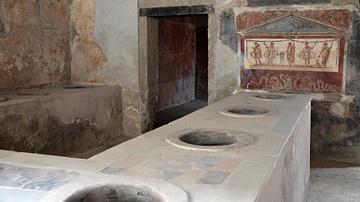
The thermopolium (cook-shop) of Vetutius Placidus in Pompeii. Thermapolia were bars which served hot food and drinks. The 'L' shaped masonry counter has large storage jars which were used to hold food...

Image
Niccolò Paganini
Niccolò Paganini, depicted in his most romantic guise, with tousled hair and gaunt cheeks, the product of his reliance on mercury and opium. Lithograph by Nicolas Eustache and Antoine Maurin, based on a painting by Pingret in...
Image
Cernunnos Rheims Relief
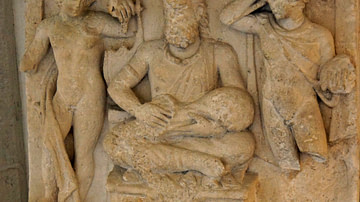
A 1st century CE bas-relief showing the Celtic god Cernunnos and Apollo (left) and Mercury (right). (Musée Saint-Remi, Rheims, France)
Image
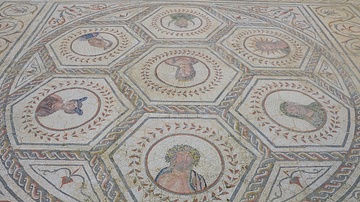
Mosaic with Busts of the Planetary Deities, Italica (Spain)
Mosaic in the House of the Planetarium in Italica (an archaeological site located in modern-day Santiponce, 9 kilometres (5.5 miles) north of Seville in Spain) with busts of the planetary deities...
Image
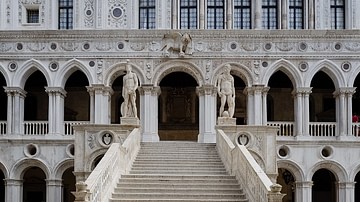
Giants' Staircase
The Giants' Staircase, with statues of Mercury and Neptune on either side, in the courtyard of the Doge's palace, Venice, Italy.
