
Search
Remove Ads
Advertisement

 This answer was generated by
 Search Results

Definition
Thirteen Colonies
The Thirteen Colonies were a cluster of British colonies located along the Atlantic seaboard of North America. Founded for a variety of reasons – economic, political, and religious – the colonies emerged with their own distinct governments...

Article
Causes of the American Revolution
The American Revolution (c. 1765-1789) was a definitive event in Western history that saw the emergence of the United States and helped spawn additional waves of revolutions and societal upheavals on both sides of the Atlantic. Though the...
Article
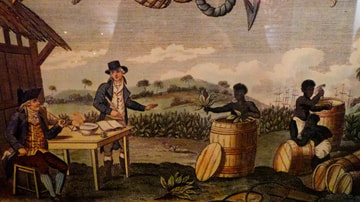
Tobacco & Colonial American Economy
The most important cash crop in Colonial America was tobacco, first cultivated by the English at their Jamestown Colony of Virginia in 1610 CE by the merchant John Rolfe (l. 1585-1622 CE). Tobacco grew in the wild prior to this time and was...

Image
Map of European Expansion & Mercantile Empires, c. 1700
A map of European empires c. 1700. By the 18th century, European power had become truly global through a combination of maritime expansion, state-backed commerce, and military force. The leading Atlantic empires, Spain, Portugal, the Dutch...

Definition
Adam Smith
Adam Smith (1723-1790) was a Scottish philosopher, economist, and leading Enlightenment figure. In The Wealth of Nations, he advocates free trade and limited interference in markets by governments, for which he is seen as the founder of liberal...

Definition
Continental System
The Continental System was a major blockade of British trade imposed by French Emperor Napoleon I from 21 November 1806 to 11 April 1814. It was designed to cripple the British economy, thereby forcing Britain out of the Napoleonic Wars (1803-1815...

Image
The Columbian Exchange - Global Connections and Consequences after 1492
The Columbian Exchange (from 1492 CE) refers to the large-scale transfer of plants, animals, diseases, peoples, and technologies between the Americas and Afro-Eurasia following the transatlantic voyages of Christopher Columbus (1451–1506...

Article
Ten Ancient Mesopotamia Facts You Need to Know - Fun Facts on the Cradle of Civilization
Mesopotamia is the ancient Greek name (meaning "the land between two rivers," the Tigris and Euphrates) for the region corresponding to modern-day Iraq and parts of Iran, Syria, and Turkey. It is considered the "cradle of civilization" for...

Article
A Brief History of Tobacco in the Americas
The history of tobacco use in the Americas goes back over 1,000 years when natives of the region chewed or smoked the leaves of the plant now known as Nicotiana rustica (primarily in the north) and Nicotiana tabacum (mostly in the south...

Image
Map of the East India Company Trade, c.1800
The English East India Company (EIC) was established by Royal Charter on 31 December 1600 under Queen Elizabeth I (reign 1558–1603), granting it a monopoly on English trade east of the Cape of Good Hope. Initially conceived as a commercial...
