
Search
Remove Ads
Advertisement
Search Results

Definition
Kellogg-Briand Pact - When 63 States Signed Up for Peace
The Kellogg-Briand Pact was an agreement signed in August 1928 by 63 countries, which all promised, after the horrors of the First World War (1914-18), to regard war as an illegal instrument of national policy. Unfortunately, this sentiment...

Definition
Samguk Sagi
The Samguk sagi ('History of the Three Kingdoms' or 'Historical Records of the Three States') is a 12th-century CE text written by Gim Busik which is considered the first history of Korea. The text covers the history of Silla, Baekje (Paekche...

Article
The Causes of WWII
The origins of the Second World War (1939-45) may be traced back to the harsh peace settlement of the First World War (1914-18) and the economic crisis of the 1930s, while more immediate causes were the aggressive invasions of their neighbours...

Article
How the United Nations was Born from WWII
The Allies met in several conferences from 1941 to 1945 to discuss how to guarantee a more peaceful and cooperative world once the Second World War (1939-45) was concluded. To foster global cooperation, facilitate free trade, and give aid...

Article
The Difference Between the Mensheviks & Bolsheviks
The Mensheviks ('Minoritarians') and Bolsheviks ('Majoritarians') were two rival factions within the Russian Social Democratic Labour Party (RSDLP), also known as the Russian Social Democratic Workers' Party (RSDWP). The split occurred in...

Article
The Invasion of Poland in 1939
The leader of Nazi Germany Adolf Hitler (1889-1945) ordered the invasion of Poland on 1 September 1939. Hitler's refusal to withdraw brought a declaration of war from Britain and France on 3 September, and so began the Second World War (1939-45...

Article
Hitler's Occupation of Czechoslovakia
Throughout 1938, Adolf Hitler (1889-1945), the leader of Nazi Germany, threatened to occupy the Sudetenland region of Czechoslovakia. The excuse presented was that Sudeten Germans were being repressed but Hitler was intent on creating a 'Greater...

Article
The Japanese Invasion of Korea, 1592-8 CE
The two Japanese invasions of Korea between 1592 and 1598 CE, otherwise known as the 'Imjin Wars', saw Toyotomi Hideyoshi (1537-1598 CE), the Japanese military leader, put into reality his long-held plan to invade China through Korea. The...

Article
Why Did Britain & France Appease Hitler?
The policy of appeasement towards the demands of Adolf Hitler (1889-1945) regarding Nazi Germany's territorial expansion ultimately failed when the Second World War (1939-45) began. The reasons appeasement was adopted by Britain and France...
Article
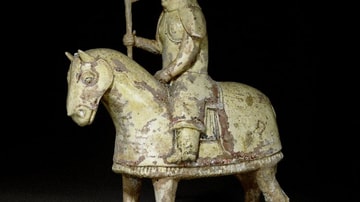
Cavalry in Ancient Chinese Warfare
The use of cavalry in Chinese warfare was a significant development which was largely responsible for the abandonment of chariots, that vehicle being much slower and more cumbersome to manoeuvre in battle conditions. The greater speed and...
