
Search
Did you mean: Empire?
Remove Ads
Advertisement
Search Results

Definition
Chariot
The chariot was a light vehicle, usually on two wheels, drawn by one or more horses, often carrying two standing persons, a driver and a fighter using bow-and-arrow or javelins. The chariot was the supreme military weapon in Eurasia...

Definition
Western Astrology
Western astrology refers to a form of divination based on the motion of astronomical objects such as stars or planets. The belief that astronomical objects are divine or influence events on Earth is found in many cultures, but...

Definition
Battle of Pydna
The Battle of Pydna in June 168 BCE was a decisive Roman victory that ended the Third Macedonian War and established Rome as the dominant power in the Mediterranean. The Roman Republic was expanding, enlarging its sphere of influence...

Definition
Napoleon's Italian Campaign
The Italian campaign of 1796-1797, waged by a young Napoleon Bonaparte, was a decisive campaign in the French Revolutionary Wars (1792-1802). It led to the defeat of Austria, the beginning of French control of northern...

Definition
Torah
The Torah, also known as the Pentateuch (from the Greek for “five books”), is the first collection of texts in the Hebrew Bible. It deals with the origins of not only the Israelites but also the entire world. Though traditionally the...

Definition
British Industrial Revolution
The British Industrial Revolution (1760-1840) brought innovative mechanisation and deep social change. The process saw the invention of steam-powered machines, which were used in factories in ever-growing urban centres...

Definition
Ancient Egyptian Burial
Egyptian burial is the common term for the ancient Egyptian funerary rituals concerning death and the soul's journey to the afterlife. Eternity, according to scholar Margaret Bunson, “was the common destination of each man...
Definition
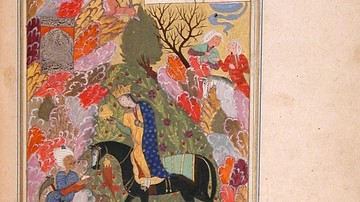
Khamsa of Nizami
Khamsa (also known as Quintet or Panj Ganj) is the best-known work of Nizami Ganjavi (c. 1141-1209 CE) and without a doubt one of the most prominent works of Persian literature. Written during the last decades of the 12th century...

Definition
Hephaistos
Hephaistos (Hephaestus) was the ancient Greek god of fire, metallurgy, and crafts. He was the brilliant blacksmith of the Olympian gods, for whom he fashioned magnificent houses, armour, and ingenious devices. Hephaistos had his workshop...
Definition
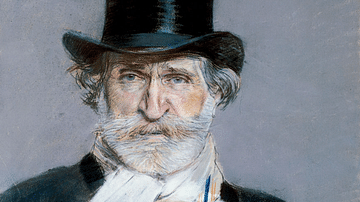
Giuseppe Verdi
Giuseppe Verdi (1813-1901) was an Italian composer best known for operas such as Rigoletto, La traviata, and Aida. Verdi is noted for his powerful scores and strong characters where anti-heroes lead the dramatic action through...
