
Search
Remove Ads
Advertisement
Search Results

Definition
Khmer Empire
The Khmer empire was a powerful state in South East Asia, formed by people of the same name, lasting from 802 CE to 1431 CE. At its peak, the empire covered much of what today is Cambodia, Thailand, Laos, and southern Vietnam. By...

Definition
Oyo Empire
The Oyo Empire flourished from the 17th to 19th century CE in what is today southwest Nigeria. The Oyo forged an empire thanks to their formidable cavalry units and so came to dominate other Yoruba peoples of the region. The Oyo Empire...

Definition
Wolof Empire
The Wolof (aka Jolof or Djolof) Empire was a state on the coast of West Africa, located between the Senegal and Gambia rivers, which thrived from the mid-14th to mid-16th century CE. The empire prospered on trade thanks to the two...

Definition
Ancient Persian Government
The government of ancient Persia was based on an efficient bureaucracy which combined the centralization of power with the decentralization of administration. The Achaemenid Empire (c. 550-330 BCE) founded by Cyrus the...

Article
The Gold Trade of Ancient & Medieval West Africa
West Africa was one of the world's greatest producers of gold in the Middle Ages. Trade in the metal went back to antiquity but when the camel caravans of the Sahara linked North Africa to the savannah...
Image
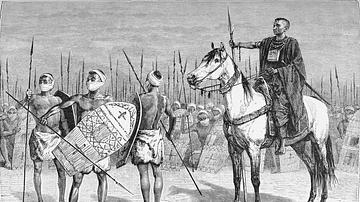
Group of Warriors from Bornu
Drawing of a group of warriors from the Bornu Empire. Drawing taken from "The earth and its inhabitants, Vol. III, West Africa" by Elisee Reclus (1830 -1905 CE) 1892 CE. From the Schomburg Center for Research in Black...

Article
Pizarro & the Fall of the Inca Empire
In 1533 CE the Inca Empire was the largest in the world. It extended across western South America from Quito in the north to Santiago in the south. However, the lack of integration of conquered peoples into that...

Interview
Rubin Museum's Faith and Empire: Tibetan Buddhist Art
Faith and Empire: Art and Politics in Tibetan Buddhism, a new exhibition at the Rubin Museum of Art in New York, explores the dynamic historical intersection of politics, religion, and art as reflected...

Article
Gibbon's Decline & Fall of the Roman Empire
The English historian Edward Gibbon (1737-1794) wrote and published his seminal work History of the Decline and Fall of the Roman Empire between 1776 and 1788. The dominant theme of Gibbon's six-volume work...

Article
Bureaucracy in the Achaemenid Empire: Learning from the Past
In the early days of the Achaemenid Empire (c. 550-330 BCE), the kings came to realise that, if they were to be able to administer the vast mass of land and the multicultural people who inhabited...
