
Search
Remove Ads
Advertisement
Search Results
Definition
Romanos I
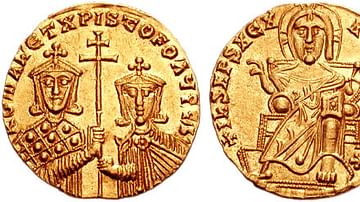
Romanos I Lekapenos (“the Ignorant”) was emperor of the Byzantine Empire from 920 to 944 CE. Of Armenian descent, he was a military commander who usurped the throne to rule as co-emperor with the rightful heir, but still minor, Constantine...

Definition
Leo VI
Leo VI was emperor of the Byzantine empire from 886-912 CE. He was the second emperor of the Macedonian dynasty and is sometimes known as “Leo the Wise” in reference to his prolific literary output which ranged from orations to law codes...

Definition
English Reformation
The English Reformation began with Henry VIII of England (r. 1509-1547 CE) and continued in stages over the rest of the 16th century CE. The process witnessed the break away from the Catholic Church headed by the Pope in Rome...

Definition
Catherine de' Medici
Catherine de' Medici (l. 1519-1589) was the queen of France, mother of three kings and two queens and, between 1559 and c. 1576, the most powerful woman in France and, possibly, all of Europe. She was the strength behind the...

Definition
Albigensian Crusade
The Albigensian Crusade (aka Cathars' Crusade, 1209-1229 CE), was the first crusade to specifically target heretic Christians - the Cathars of southern France. Not successful in repressing the heresy, the on-off campaigns over...

Definition
British Crown Jewels
The Crown Jewels of the monarchy of the United Kingdom of Great Britain and Northern Ireland are today kept in the Tower of London and date mostly to the 17th century, with a few later sparkling additions such as the Koh-i-Noor...

Definition
James IV of Scotland
James IV of Scotland ruled as king from 1488 to 1513. He succeeded his father James III of Scotland (r. 1460-1488) and became one of the most popular of the Stuart kings. James sought to apply justice in every corner of his...

Article
Was Cleopatra Beautiful?
The idea that Cleopatra VII (69-30 BCE), the famous last queen of ancient Egypt, owed her powerful position to her beauty persists. “The nose of Cleopatra: if it had been shorter, the whole face of the earth would have...

Article
The Six Wives of Henry VIII
In his search to secure the continuation of the Tudor line, Henry VIII of England (r. 1509-1547 CE) married an incredible six times. Some marriages were the result of passion while others were arranged for political reasons...
Article
Legions of the Dacian Wars
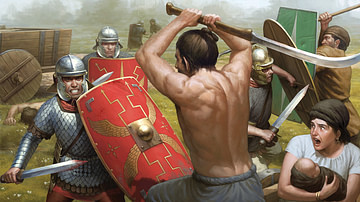
The Dacian Wars started after Decebalus (r. c. 87-106 CE) raided the Roman province of Moesia in 85 CE. Emperor Domitian's (r. 81-96 CE) Dacian campaigns in 86-87 CE reached an uneasy peace, but the conflict was renewed...
