
Search
Remove Ads
Advertisement
Search Results
Definition
Cyrus the Great
Cyrus II (d. 530 BCE), also known as Cyrus the Great, was the fourth king of Anshan and the first king of the Achaemenid Empire. Cyrus led several military campaigns against the most powerful kingdoms of the time, including Media...

Definition
Constantinople
Built in the seventh century BCE, the ancient city of Byzantium proved to be a valuable city for both the Greeks and Romans. Because it lay on the European side of the Strait of Bosporus, the Emperor Constantine understood its...

Definition
Ancient Persian Government
The government of ancient Persia was based on an efficient bureaucracy which combined the centralization of power with the decentralization of administration. The Achaemenid Empire (c. 550-330 BCE) founded by Cyrus the...

Definition
Vikings
The Vikings were originally diverse Scandinavian seafarers from Norway, Sweden, and Denmark (though other nationalities were later involved) whose raids and subsequent settlements significantly impacted the cultures of Europe and were...

Definition
Yuan Dynasty
The Yuan Dynasty was established by the Mongols and ruled China from 1271 to 1368. Their first emperor was Kublai Khan (r. 1260-1294) who finally defeated the Song Dynasty which had reigned in China since 960. Stability and peace...
Definition
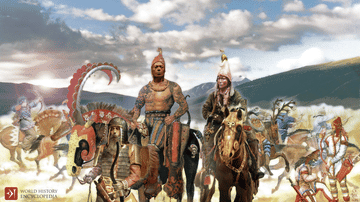
Scythians
The Scythians were a nomadic people whose culture flourished between the 7th and 3rd century BCE in a territory ranging from Thrace in the west, across the steppe of Central Asia, to the Altai Mountains of Mongolia in the east. This...
Definition
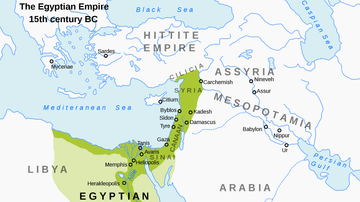
Egyptian Empire
The Egyptian Empire rose during the period of the New Kingdom (c. 1570- c. 1069 BCE), when the country reached its height of wealth, international prestige, and military might. The empire stretched from modern-day Syria in the...

Definition
Hadrian
Hadrian (l. 78-138 CE) was emperor of Rome (r. 117-138 CE) and is recognized as the third of the Five Good Emperors (Nerva, Trajan, Hadrian, Antoninus Pius, and Marcus Aurelius) who ruled justly. His reign marked the height of the Roman...

Definition
Iranian Revolution
The Iranian Revolution (1978-1979) was the social movement that arose from widespread and diverse discontent with the monarchic government of Iran. The revolution was fought against the regime of Mohammad Reza Shah (r. 1941-1979...

Definition
Ur-Nammu - Founder of the Sumerian Renaissance
Ur-Nammu (circa 2112-2094 BCE) was the founder of the Third Dynasty of Ur in Sumer, who initiated the so-called Ur III period (circa 2112 to circa 2004 BCE), also known as the Sumerian Renaissance. He is...
