
Search

 This answer was generated by
 Search Results
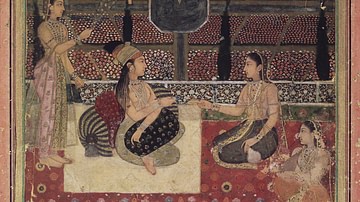
Definition
Urdubegis
The urdubegis were a group of female warriors in the Mughal Empire, who protected the zenana, the harem of the emperor. Although the origins of female bodyguards go back to the beginning of Indian civilizations, the urdubegis were a Mughal...
Image
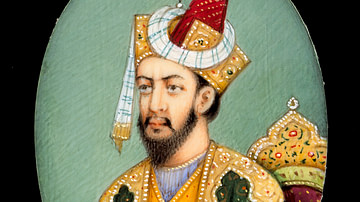
Emperor Humayun
Mughal Emperor Humayun (r. 1530-1540/1555-1556), son of Emperor Babur, father of Emperor Akbar, miniature painting, opaque watercolor and gold on ivory, India, Delhi, c. 1875.
Los Angeles County Museum of Art

Video
Humayun's Tomb, Delhi (UNESCO/NHK)
This tomb, built in 1570, is of particular cultural significance as it was the first garden-tomb on the Indian subcontinent. It inspired several major architectural innovations, culminating in the construction of the Taj Mahal. Source...
Image
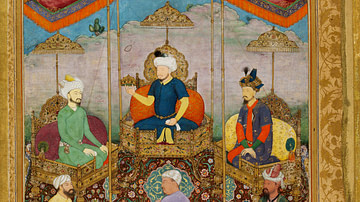
Timur Handing the Crown to Babur
This painting establishes the Mughal Dynasty depicting Timur Lane handing the crown to his grandson Babur who has his own son and heir Humayun also present. Legend has it that as Humayun languished at the doors of death with a toxic fever...

Article
Royal Women in the Mughal Empire
It was not only the Mughal emperors that left an indelible mark in the history of the Indian subcontinent but also the queens and princesses. The latter's contributions to art, architecture, literature, cuisine, refinement, and administrative...

Article
Mehrauli Archaeological Park
Mehrauli Archaeological Park is situated in Delhi, just beside the Qutb Complex (historically, Mehrauli was the first of the seven cities of Delhi). Spanning an area of more than 200 acres (80 ha), the site displays the rich heritage of India...
Image
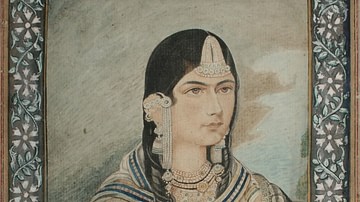
Hamida Banu Begum
Hamida Banu Begum (c. 1527 to 29 August 1604), wife of Mughal Emperor Humayun, mother of Emperor Akbar, miniature painting, opaque watercolor or gouache on paper, Lucknow School of painting, c. late 19th century.
Image
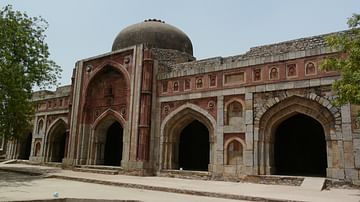
Jamali Kamali Mosque
Jamali Kamali mosque, built by Mughal emperors Babur and Humayun between 1528-1529 and 1536.
Mehrauli Archaeological Park, Delhi.

Video
The History of the Great Mughals, Babur to Aurangzeb | 1483 - 1707
The Mughal Empire ruled parts of the Indian Subcontinent for more than three centuries. In that time, it transformed India into what it is today. The Mughals came as outsiders from Central Asia who conquered India with steel and gunpowder...
