
Search
Remove Ads
Advertisement
Search Results

Video
European Migration: Crash Course
Between 1840 and 1914 CE, an estimated 40 million people left Europe. This is one of the most significant migrations in human history. So, who was leaving Europe? And why?

Video
Forgotten History: the Romani (Gypsy) Migration from India to Europe
The Romani (colloquially known as the "Gypsies") are a community of European itinerants with surprising origins in northwest India. In this video, we explore the fascinating histories...
Image
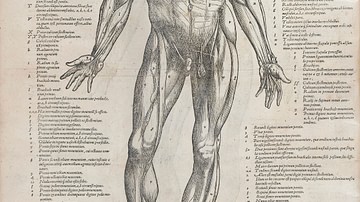
Page from On the Fabric of the Human Body
An intricately labelled diagram of the human muscles from Andreas Vesalius' (1514-1564) celebrated book on anatomy, On the Fabric of the Human Body, first published in 1543. (Wellcome Images)

Image
Standing Human Statue from Ain Ghazal
This statue was made of lime plaster, reed, and bitumen and was found in modern-day Ain Ghazal city in the outskirt of Amman, Jordan Hashemite Kingdom. Between 1983-1985 CE, 15 statues and 15 busts made of lime...

Image
Human Statue from Ain Ghazal
This statue was made of lime plaster, reed, and bitumen and was found in modern-day Ain Ghazal city in the outskirt of Amman, Jordan Hashemite Kingdom. Between 1983-1985 CE, 15 statues and 15 busts made of lime plaster...
Image
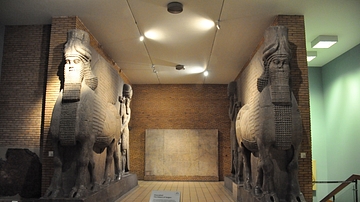
Human-Headed Winged Bulls and Genies from Khorsabad
A pair of human-headed and winged-bulls (lamassu), stood on either side of a gate at one of the citadel walls at Khorsabad. Two human-headed and winged protective spirits or genies stand behind the...

Image
Vesalius Dissecting a Human Body
The frontispiece of On the Fabric of the Human Body (1543) by Andreas Vesalius (1514-64). The anatomist is shown making a dissection of a human body. (National Library of Medicine)
Image
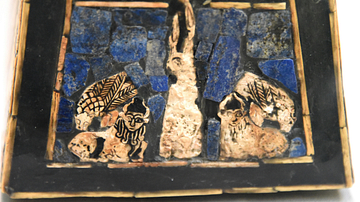
Human-Headed Bull in the Standard of Ur
This is one of the scenes depicted on one of the sides of the Standard of Ur; this is not part of the so-called "Peace and War Scenes" of the Standard. Here, at the center, there is what appears to be a tall...
Image
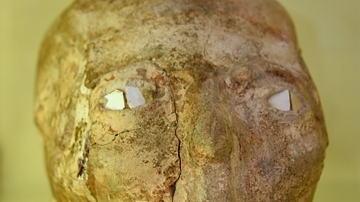
Plaster Model of Human Head
This human head and its face were modeled in plaster and the mouth area was filled in completely. The eye sockets were inlaid with bivalve shells, divided into two halves. Many human bodies were found headless in tombs...

Definition
Brahmanism
Brahmanism (also known as Vedic Religion) is the belief system that developed from the Vedas during the Late Vedic Period (c. 1100-500 BCE) originating in the Indus Valley Civilization after the Indo-Aryan Migration c. 2000-1500 BCE...
