
Search
Did you mean: Jeremiah?
Remove Ads
Advertisement
Search Results

Definition
Horus
Horus is the name of a sky god in ancient Egyptian mythology which designates primarily two deities: Horus the Elder (or Horus the Great), the last born of the first five original gods, and Horus the Younger, the son of Osiris and Isis...

Definition
Astrolabe
The astrolabe is an astronomical instrument used from around the 6th century to measure time and position by determining the altitude of heavenly bodies like the Sun and certain stars. Measurements were taken in reference to the viewer's...

Definition
Greek Colonization
From around 800 BCE, ancient Greek city-states, most of which were maritime powers, began to look beyond Greece for land and resources. As a consequence, they founded colonies across the Mediterranean. Trade was usually the...

Definition
Edmond Halley
Edmond Halley (1656-1742) was an English astronomer, mathematician, and cartographer. Halley's Comet is named after him since he accurately predicted its return in 1758. One of the early globetrotting scientists, Halley led several...
Definition
Lyre
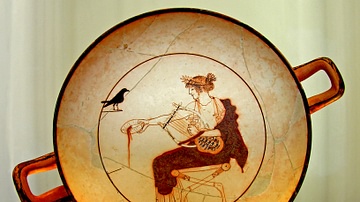
The lyre was a stringed musical instrument played by the ancient Greeks. It was probably the most important and well-known instrument in the Greek world. The lyre was closely related to the other stringed instruments: the chelys which...
Definition
Stamp Act
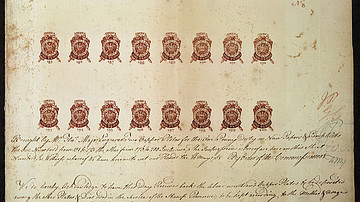
The Stamp Act of 1765 was the first direct tax imposed on the 13 American colonies by the Parliament of Great Britain. It required the colonists to pay a tax on all printed materials including newspapers, legal documents, magazines...

Definition
Perdiccas
Perdiccas (d. 321 BCE) was one of Alexander the Great's commanders, and after his death, custodian of the treasury, regent over Philip III and Alexander IV, and commander of the royal army. When Alexander the Great crossed the Hellespont...

Definition
Townshend Acts
The Townshend Acts were a series of acts passed by the Parliament of Great Britain between 1767 and 1768 to tax and regulate the Thirteen Colonies of North America. When the colonists considered the acts an abuse of power and protested...

Definition
Sumer - The Cradle of Civilization
Sumer was the southernmost region of ancient Mesopotamia (modern-day southern Iraq and parts of Kuwait), which has long been considered the cradle of civilization. The name comes from Akkadian, the language of the...

Definition
Joseph Haydn
Joseph Haydn (1732-1809) was an Austrian composer of Classical music who is widely regarded as one of the greatest composers in history. Haydn spent most of his career around Vienna, where he pioneered the symphony and string quartet...
