
Search
Remove Ads
Advertisement

 This answer was generated by
 Search Results
Image
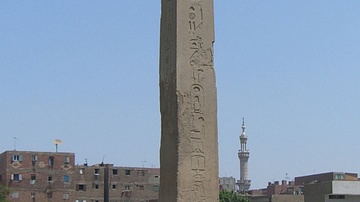
Obelisk of Senusret I, Heliopolis
The only Egyptian obelisk still standing in its original position is that of Senusret I (c. 1971-1926 BCE) at the site of a former temple to the sun god at Heliopolis.

Article
Egyptian Gods - The Complete List
The gods and goddesses of Ancient Egypt were an integral part of the people's everyday lives for over 3,000 years. There were over 2,000 deities in the Egyptian pantheon, many whose names are well known - Isis, Osiris...

Definition
Egyptian Obelisk
An obelisk is a stone rectangular pillar with a tapered top forming a pyramidion, set on a base, erected to commemorate an individual or event and honor the gods. The ancient Egyptians created the form at some point in the Early...

Definition
Nephthys
Nephthys was one of the original five gods of ancient Egypt born of the union of Geb (earth) and Nut (sky) after the creation of the world. She was the fourth born after Osiris, Isis, and Set and was the older sister of Horus (usually...
Definition
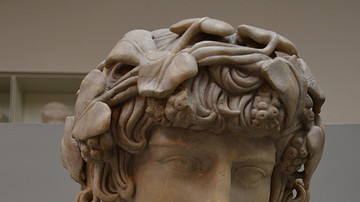
Antinous
Antinous (l. c. 110-130 CE) was a youth of Bithynia who became the beloved of the Roman emperor Hadrian (l. 76-138 CE, r. 117-138 CE) from around the age of 13 until his death at nearly 20. His year of birth is unknown as are any details...

Definition
Baalbek
Baalbek is an ancient Phoenician city located in what is now modern-day Lebanon, north of Beirut, in the Beqaa Valley. Inhabited as early as 9000 BCE, Baalbek grew into an important pilgrimage site in the ancient world for the worship...

Definition
Ra (Egyptian God)
Ra (also given as Re) is the sun god of ancient Egypt. He is one of the oldest deities in the Egyptian pantheon and was later merged with others such as Horus, becoming Ra-Horakhty (the morning sun), Amun (as noonday sun), and...

Definition
Phoenicia
Phoenicia was an ancient civilization composed of independent city-states located along the coast of the Mediterranean Sea stretching through what is now Syria, Lebanon and northern Israel. The Phoenicians were a great maritime people...
Image
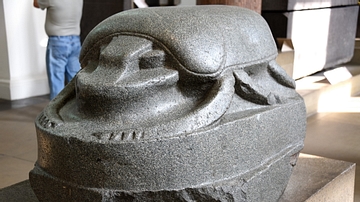
Colossal Scarab
This is one of the largest representations of scarab beetles to survive. It also ranks among the last great statues of any pharaonic deity. The scarab represented Khepri, the form assumed by the sun-god at dawn. The Egyptians...
Image
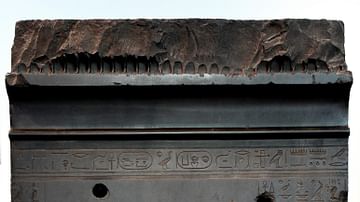
Screen Slab of King Nectanebo I
This slab enclosed a sacred spot in the temple of Atum, a creator god, Heliopolis. King Nectanebo I is shown kneeling and making offerings. In this scene, he presents a loaf of bread. On the other side (now damaged...
