
Search
Remove Ads
Advertisement
Search Results

Image
French Soldiers Inspect Goods in Leipzig
French soldiers inspect goods in Leipzig in 1806, near the start of Napoleon's Continental System. By Gottfried Heinrich Geißler, 1824.

Image
Himmler & Röhm
An August 1933 photograph showing Heinrich Himmler (centre), head of the SS, and Ernst Röhm (right), leader of the Sturmabteilung (SA), rival paramiliatray groups of the German Nazi party. (German Federal Archives)
Image
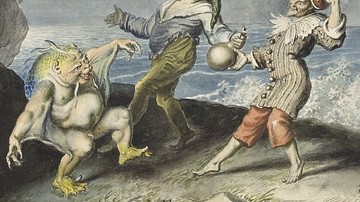
Caliban, Stephano, and Trinculo
Caliban, Stephano, and Trinculo from William Shakespeare's play The Tempest (1611). By Johann Heinrich Ramberg, c. 19th century.
Cornell University.

Image
Declaration of Pillnitz
Meeting of European rulers at the Pillnitz Conference, famous for the Declaration of Pillnitz, which was issued on 27 August 1791 and threatened Revolutionary France with invasion. Depicted in the center are Leopold II, Holy Roman Emperor...

Image
Kekrops Looking on as Gaia Gives Erechtheus to Athena
Gaia offers Erichthonios to Athena, with Kekrops watching. Clay relief from Melos, c. 460 BCE. Illustration from Ausführliches Lexikon der griechischen und römischen Mythologie by Wilhelm Heinrich Roscher, 1890. Kekrops, the mythical king...
Image
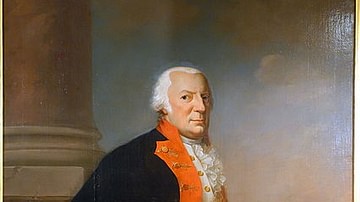
Portrait of the Duke of Brunswick in the 1790s
Charles William Ferdinand, Duke of Brunswick, in the 1790s, portrait by Johann Heinrich Schröder c. 1790-95.
Braunschweigisches Landesmuseum.
Image
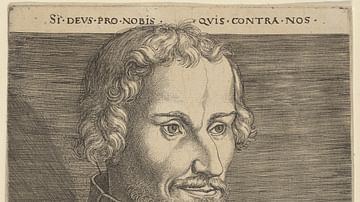
Portrait of Philip Melanchthon
Philip Melanchthon (1497-1560), German Lutheran reformer, engraving by Heinrich Aldegrever, 1540.
Metropolitan Museum of Art, New York.

Article
Lost Civilisations of Anatolia: Göbekli Tepe
Göbekli Tepe is the world's oldest example of monumental architecture; a 'temple' built at the end of the last Ice Age, 12,000 years ago. It was discovered in 1995 CE when, just a short distance from the city of Şanliurfa in Southeast Turkey...

Article
Interview with Gordon Campbell
In this interview, World History Encyclopedia talks to author and scholar Gordon Campbell all about his new book Norse America: The Story of a Founding Myth published by Oxford University Press. Kelly (WHE): Thanks for joining me today...
Image
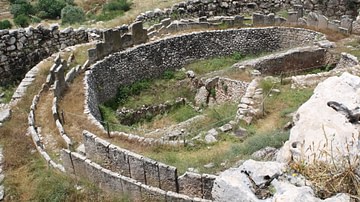
Grave Circle A, Mycenae
The royal grave circle within the walls of Mycenae (1600 BCE). It was in the shaft graves here that Heinrich Schliemann discovered in 1876 CE the famous gold death mask attributed (incorrectly) to King Agamemnon.
