
Search
Search Results

Definition
Ptolemaic Dynasty
The Ptolemaic dynasty was a Macedonian royal family that ruled Ptolemaic Egypt from 323 to 30 BCE. It was founded by Ptolemy I, a general and successor of Alexander the Great. They built Alexandria, including the Lighthouse of Alexandria...

Definition
Ancient Egyptian Warfare
The Narmer Palette, an ancient Egyptian ceremonial engraving, depicts the great king Narmer (c. 3150 BCE) conquering his enemies with the support and approval of his gods. This piece, dating from c. 3200-3000 BCE, was initially thought to...

Article
Sassanian Kings List & Commentary
The Sassanian Empire (224-651) was the greatest expression of Persian culture in the ancient world. It was consciously modeled on the earlier Achaemenid Empire (c. 550-330 BCE) which established Persian supremacy in the region and developed...

Definition
Seleucid Empire
The Seleucid Empire (312-63 BCE) was the vast political entity established by Seleucus I Nicator ("Victor" or "Unconquered", l. c. 358-281 BCE, r. 305-281 BCE), one of the generals of Alexander the Great who claimed a part of his empire after...

Article
The Temple of Hatshepsut
Among the duties of any Egyptian monarch was the construction of monumental building projects to honor the gods and preserve the memory of their reigns for eternity. These building projects were not just some grandiose gesture on the part...

Definition
Hatshepsut
Hatshepsut (r. 1479-1458 BCE) was the first female ruler of ancient Egypt to reign as a male with the full authority of pharaoh. Her name means "Foremost of Noble Women" or "She is First Among Noble Women". She began her reign as regent to...

Definition
Middle Kingdom of Egypt
The Middle Kingdom (2040-1782 BCE) is considered ancient Egypt's Classical Age during which it produced some of its greatest works of art and literature. Scholars remain divided on which dynasties constitute the Middle Kingdom as some argue...

Definition
John Balliol
John Balliol ruled as the king of Scotland from 1292 to 1296 CE. He was supported by Edward I of England (r. 1272-1307 CE) in the competition to find the successor to the heirless Alexander III of Scotland (r. 1249-1286 CE), a process known...

Article
Lost Civilisations of Anatolia: Göbekli Tepe
Göbekli Tepe is the world's oldest example of monumental architecture; a 'temple' built at the end of the last Ice Age, 12,000 years ago. It was discovered in 1995 CE when, just a short distance from the city of Şanliurfa in Southeast Turkey...
Image
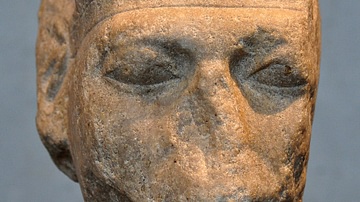
Pharaoh Senusret III
Quartzite head of the Egyptian pharaoh Senusret III (aka Sesostris III) with aged features. Middle Kingdom, 12th Dynasty, 1850 BCE. (State Museum of Egyptian Art, Munich, Germany).
