
Search
Remove Ads
Advertisement
Search Results

Definition
Selinus
Selinus (or Selinous, modern: Selinunte), located on the south-west coast of Sicily, was founded in the mid-7th century BCE by Greek colonists from Megara Hyblaea on the eastern side of the island. Selinus was the most western Greek...

Definition
Silk in Antiquity
Silk is a fabric first produced in Neolithic China from the filaments of the cocoon of the silk worm. It became a staple source of income for small farmers and, as weaving techniques improved, the reputation of Chinese silk spread...
Definition
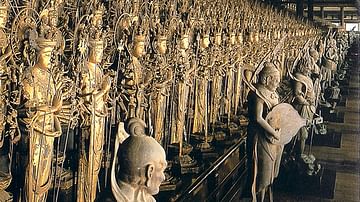
Sanjusangendo
Sanjusangendo is a Buddhist temple which is part of the Rengeo-in monastery in Kyoto, Japan. Founded in 1164 CE, the temple is famous for its impressive dimensions and the 1,001 golden Buddha figures and 28 guardian statues which...

Definition
Tushpa
Tushpa, later known as Van, was the capital of the Urartu kingdom of ancient Armenia, eastern Turkey, and western Iran from the 9th to 6th century BCE. Located on the eastern shore of Lake Van in modern Turkey, the city was a fortress...

Definition
Scythian Art
Scythian art is best known for its 'animal art.' Flourishing between the 7th and 3rd centuries BCE on the steppe of Central Asia, with echoes of Celtic influence, the Scythians were known for their works in gold. Moreover, with the...

Definition
Samos
Samos is a Greek island in the east Aegean, just off the coast of modern-day Turkey. It particularly flourished in the 6th century BCE and was famous in antiquity for its navy, wine, and important sanctuary to Hera. Samos was an active...

Definition
Stupa
A stupa (literally “heap” or “pile”) is a reliquary, a shrine containing the remains of a holy or sainted person and/or artifacts (relics) associated with them, originating in India prior to the 5th century BCE as tombs of holy men and...

Definition
Cerveteri
Cerveteri (Etruscan name: Cisra or Caisra, Greek: Agylla, Roman: Caere) was an important Etruscan town which flourished between the 7th and 4th century BCE. Located near the western coast of central Italy, around 50 km north of Rome...

Definition
Ancient Greek Pottery
Greek pottery has four main types: Geometric, Corinthian, Athenian Black-figure, and Athenian red-figure pottery. Pottery vessels were made for everyday use such as the two-handled amphora for storage, the single-stem kylix...

Definition
Charon - The Ferryman to the Dead in Greek Mythology
Charon is a figure from Greek mythology where he is the boatman who ferries the souls of the dead across the waters of Hades to the judgement which will determine their final resting place. The Greeks...
