
Search
Remove Ads
Advertisement
Search Results

Article
The Foundation of the Royal Society
The Royal Society was founded in 1662 to promote scientific research and increase our knowledge of the natural world. With royal patronage and a stellar membership of great minds, the society quickly gained international...

Article
Ten Ancient Rome Facts You Need to Know
Ancient Roman culture affected vast numbers of people across the known world of its time, beginning with the rise of the Roman Republic (509-27 BCE) and throughout the duration of the Roman Empire (27 BCE -...

Article
Ancient Celtic Society
The society of the Celts in Iron Age Europe was made up of several distinct hierarchical groups. At the top were rulers and elite warriors, then there were the religious leaders, the druids, and then specialised craftworkers...

Article
Henry IV of France & the Edict of Nantes
Henry of Navarre became the nominal ruler of France after the assassination of Henry III of France (r. 1574-1589), whose marriage to Louise de Lorraine produced no heir. After years of attempts to deny the...

Article
Antoine Court & the Church of the Desert
In March 1715, Louis XIV of France (r. 1643-1715) issued a declaration stating that all subjects of the king were also subjects of the Catholic Church. In defiance of the king's decree, Antoine Court (l. 1696-1760...

Article
Observatories in the Scientific Revolution
The foundation of observatories during the Scientific Revolution (1500-1700) followed a process of evolution from entirely independent observatories operated by a single astronomer to private observatories...

Article
The Origins of British Pub Names
Pubs remain a prominent feature of the rural and urban landscapes of Britain, but their names very often date back to medieval times. Red lions, white horses, and colourful characters peer from pub signs as landlords...
Interview
Interview: Barry Strauss on Ten Caesars
Dr. Barry Strauss' Ten Caesars: Roman Emperors from Augustus to Constantine tells the epic story of the Roman Empire from its rise to its eastern reinvention, from Augustus, who founded the empire, to Constantine...

Image
Map of the Spanish Empire and the Indies (c. 1500-1820)
The emergence of Spain as a global imperial power began with the dynastic union of the crowns of Castile and Aragon under Isabella I of Castile (reign 1474–1504) and Ferdinand II of Aragon (reign...
Image
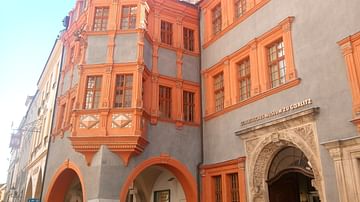
The Silesian Museum in Görlitz
With 2,000 square meters of exhibition space, the permanent exhibition offers numerous insights into the diverse and eventful cultural history of Silesia and explores the multicultural character of the region's history...
