
Search
Remove Ads
Advertisement
Search Results

Definition
Great Exhibition
The 1851 Great Exhibition was held in the purpose-built Crystal Palace in Hyde Park, London, to showcase the latest developments in engineering, science, and the arts, as well as objects of cultural significance from Britain and...
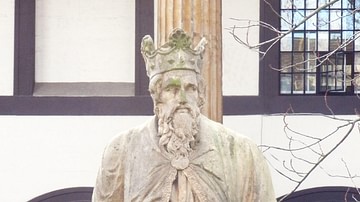
Image
Alfred the Great Statue, London
Statue of Alfred the Great (r. 871-899), in Trinity Church Square, Southwark, London, designed by James George Bubb in 1824.

Definition
Great Zimbabwe
Great Zimbabwe is a ruined city near Masvingo, central Zimbabwe which was inhabited between c. 1100 to c. 1550 (flourishing c. 1300 - c. 1450) in the region’s Late Iron Age. Capital of the Kingdom of Zimbabwe of the Bantu-speaking...

Article
Alexander the Great & the Burning of Persepolis
In the year 330 BCE Alexander the Great (l. 356-323 BCE) conquered the Achaemenid Persian Empire following his victory over the Persian Emperor Darius III (r. 336-330 BCE) at the Battle of Gaugamela in...

Image
Ateshgah Fire Temple
Ateshgah Fire Temple, Azerbaijan.

Image
Fire Temple
Baku Ateshgah or the Fire Temple of Baku, Azerbaijan.

Image
Natanz Fire Temple
Sassanian Fire Temple, Natanz, Iran.

Definition
Great Northern War
The Great Northern War took place from 1700 to 1721 and was fought between Russia and Sweden during the reign of Peter I of Russia (Peter the Great). One of the key causes of the war was Peter the Great’s desire to have territory...

Definition
William IV of Great Britain
William IV of Great Britain (r. 1830-1837) succeeded his elder brother George IV of Great Britain (r. 1820-1830) to become the fifth Hanoverian monarch. William had a successful naval career, and his reign is best remembered...

Definition
Alexander the Great
Alexander III of Macedon, better known as Alexander the Great (l. 21 July 356 BCE – 10 or 11 June 323 BCE, r. 336-323 BCE), was the son of King Philip II of Macedon (r. 359-336 BCE) who became king upon his father's death in...
