
Search
Remove Ads
Advertisement
Search Results

Definition
Marcus Aurelius
Marcus Aurelius (r. 161 to 180 CE) was a Roman emperor best known as the last of the Five Good Emperors of Rome (following Nerva, Trajan, Hadrian, and Antoninus Pius) and as the author of the philosophical work Meditations. Although...

Definition
Knights' Revolt
The Knight’s Revolt (1522-1523) was a military action led by the German imperial knight Franz von Sickingen (l. 1481-1523) and encouraged by the knight and writer Ulrich von Hutten (l. 1488-1523) launched to restore the status...
Definition
Pawnee
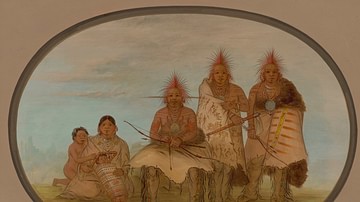
The Pawnee are a Native American nation of the Plains Indians culture originally from the region of modern Nebraska. Prior to the European colonization of the Americas, they were among the most powerful of the Plains Indian tribes numbering...

Definition
Roman Cavalry
Cavalry, although never replacing infantry as the mainstay of the Roman army, could provide useful cover on the flanks of armies, could be used as a shock tactic to cause disruption to enemy infantry formations, and could pursue...

Definition
Carthaginian Army
The armies of Carthage permitted the city to forge the most powerful empire in the western Mediterranean from the 6th to 3rd centuries BCE. Although by tradition a seafaring nation with a powerful navy, Carthage, by necessity...

Definition
Pushyabhuti Dynasty
The Pushyabhuti Dynasty (c. 500 CE - 647 CE) rose after the downfall of the Gupta Empire (3rd century CE - 6th century CE) in the 6th century CE in northern India. Also known as the Vardhana or Pushpabhuti Dynasty, the core...

Definition
Ashoka the Great
Ashoka the Great (r. 268-232 BCE) was the third king of the Mauryan Empire (322-185 BCE) best known for his renunciation of war, development of the concept of dhamma (pious social conduct), and promotion of Buddhism as well as...

Article
Artillery in Medieval Europe
Artillery weapons in medieval Europe included the mounted crossbow (ballista) and single-arm torsion catapult (mangonel), both similar to ancient Roman machines. As armies battled further afield such as in the Byzantine...

Article
How Germany Lost World War I
Germany started the First World War (1914-18) with the belief its armed forces could win a quick and decisive victory over France and then Russia. The reality turned out to be much more complicated as more countries...

Definition
Peninsular War
The Peninsular War (1807-1814), also known as the War of Spanish Independence, was a major conflict of the Napoleonic Wars (1803-1815) that was waged in the Iberian Peninsula by Portugal, Spain, and the United Kingdom against the...
