
Search
Did you mean: Lumbini?
Remove Ads
Advertisement

 This answer was generated by
 Search Results
Image
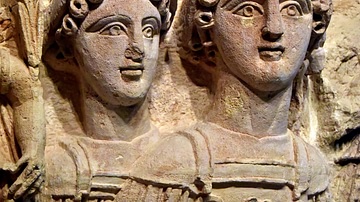
Gemini from the Adh-Dharish Temple Facade
This sculpture of Gemini was part of the temple's facade. The temple was designed according to classical fashion. It contains major constitutional elements of the classical architectural order, but its decoration...

Definition
Castor and Pollux
Castor and Pollux (the Dioscuri) are figures from Greek and Roman mythology considered the twin sons of Zeus or Jupiter. Semi-divine figures, the twins were credited with the role of saving those in trouble at sea or in grave...

Definition
Hellenistic Astrology
Hellenistic astrology encompassed various forms of divination in Greece and the Mediterranean, all linked to the observation of astronomical phenomena. Hellenistic astrology was based on the belief that the stars and planets...
Article
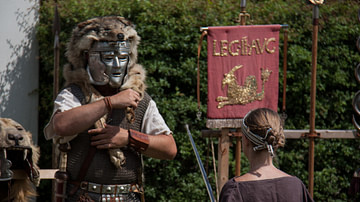
Legions of Britain
After the Roman emperor Claudius (r. 41-54 CE) successfully conquered Britain in 43 CE, four legions were left there to maintain the peace: XIV Gemina, II Augusta, IX Hispana, and XX Valeria Victrix. However, by the end of the...

Article
The Year of the Four Emperors & the Demise of Four Roman Legions
During the Year of the Four Emperors (69 CE), the fight between Vitellius and Vespasian would ultimately bring about the demise of four legions, the XV Primigenia, I Germanica, IIII Macedonica...

Article
Legions of Judea
Judea was initially dependent on its neighbor Syria for military support until it received a Roman legion of its own in 70 CE after the Great Jewish Revolt of 66 CE. Legio X Fretensis was stationed at remains of the burned city...
Article
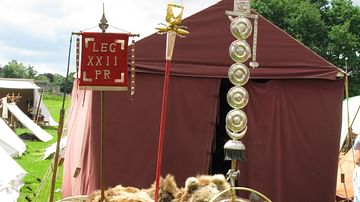
Legions of the Rhine Frontier
After Julius Caesar’s (100-44 BCE) conquest of Gaul, Roman legions pushed the borders of the Roman Empire’s frontier to the banks of the Rhine River. Augustus (r. 27 BCE - 14 CE) divided the newly acquired region into...

Article
Temple of Castor & Pollux
The Temple of Castor and Pollux in the Roman Forum of Rome was erected in the final decade of the 1st century BCE, replacing the earlier temple to the twin sons of Jupiter which had stood on the site since 484 BCE. Today...

Article
Legions of Spain, Roman Africa & Egypt
The legions of Spain, Roman Africa, and Egypt did not see the intensity of action that prevailed elsewhere in Europe. However, the presence of these four legions - VII Gemina, IX Hispana, XXII Deiotariana, and...
Article
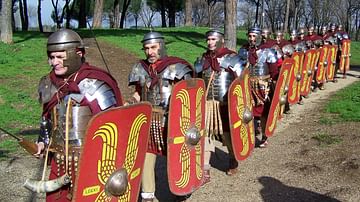
Legions of Moesia
The province of Moesia was vital to the Roman military’s protection of the Balkans. Subdued by the Roman commander Marcus Licinius Crassus in 29 BCE, it was initially part of Macedonia. Due to its location along the Danube, it...
