
Search
Did you mean: Mali Empire?
Remove Ads
Advertisement
Search Results

Definition
Ambiorix
Ambiorix (c. 54/53 BCE) was the co-ruler of the Eburone tribe of Gallia Belgica (north-eastern Gaul, modern-day Belgium) who led an insurrection against Caesar's occupying forces in Gaul in the winter of 54/53 BCE. Nothing is known...

Article
Cortés & the Fall of the Aztec Empire
The Aztec empire flourished between c. 1345 and 1521 CE and dominated ancient Mesoamerica. This young and warlike nation was highly successful in spreading its reach and gaining fabulous wealth, but then all too...

Article
Sassanian Kings List & Commentary
The Sassanian Empire (224-651) was the greatest expression of Persian culture in the ancient world. It was consciously modeled on the earlier Achaemenid Empire (c. 550-330 BCE) which established Persian supremacy...

Article
Trade in the Byzantine Empire
Trade and commerce were essential components of the success and expansion of the Byzantine Empire. Trade was carried out by ship over vast distances, although for safety, most sailing vessels were restricted to the...

Article
The Roman Empire in West Africa
At its fullest extent, the Roman Empire stretched from around modern-day Aswan, Egypt at its southernmost point to Great Britain in the north but the influence of the Roman Empire went far beyond even the borders of...

Article
Enheduanna - Poet, Priestess, Empire Builder - Redefining the Gods for the People
Enheduanna (circa 2300 BCE) is the world's first author and was the daughter (either literally or figuratively) of the great empire-builder Sargon of Akkad (reign 2334-2279 BCE...
Definition
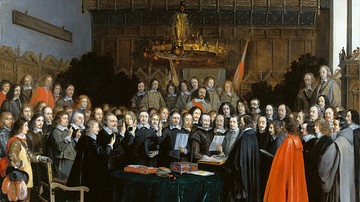
Peace of Westphalia
The Peace of Westphalia, the name given to the multiple treaties, marked the conclusion of the Thirty Years' War. Signed on 24 October 1648, it aimed to secure political autonomy for the multitude of small states that made...

Article
Royal Women in the Mughal Empire
It was not only the Mughal emperors that left an indelible mark in the history of the Indian subcontinent but also the queens and princesses. The latter's contributions to art, architecture, literature, cuisine, refinement...

Article
Society in the Byzantine Empire
The society in the Byzantine Empire (4th-15th century CE) was dominated by the imperial family and the male aristocracy but there were opportunities for social advancement thanks to wars, population movements, imperial...

Article
Women in the Byzantine Empire
Women in the Byzantine Empire (4th to 15th century CE) were, amongst the upper classes, largely expected to supervise the family home and raise children while those who had to work for a living did so in most of the...
