
Search
Remove Ads
Advertisement
Search Results

Article
Top 10 Archaeological Sites in Provence
Provence has inherited a rich legacy from antiquity, boasting some of the best-preserved Roman ruins in Europe. In the 2nd century BCE, the Romans began their conquest of the region and called it “Provincia...
Article
Legions of Syria
The Roman legions of Syria served as a buffer, protecting the Roman Empire not only externally from such threats as Parthia and the Sasanian Empire but also internally during the Great Jewish Revolt of 66 CE and the Bar-Kochba...

Image
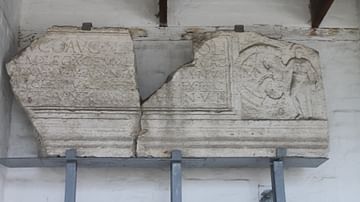
Inscription, Arch of Constantine I
The inscription which appears on both sides of the Arch of Constantine I in Rome. Dedicated in 315 CE, the triumphal arch celebrates the emperor's victory over the Roman tyrant Maxentius in 312 CE. The inscription...

Image
Caesarea Maritima Digital Reconstruction
One of the most remarkable builds of the ancient world, the metropolis of Caesarea Maritima was literally built from the ground up. In the latter years of the 1st century BCE, as a port city, it served Rome’s...

Image
Cardo Maximus, Caesarea Maritima
As the city of Caesarea Maritima was built on an east-west axis, with the temple in between the city and Herod's harbor, the magnificent Cardo Maximus set the tone for those getting to their desired destinations...

Image
The Amphitheater of Caesarea Maritima
As Caesarea Maritima was a center of sporting events in the Mediterranean world, Herod the Great assigned this building to host games every five years, which likely included wrestling, boxing matches, gymnastic...

Image
Hippodrome, Caesarea Maritima
Home to one of the most popular ancient sports, chariot racing, the hippodrome at Caesarea Maritima was one of the main structures in the city. Dating to the 2nd century CE, it is located along the coast south of the...
Image
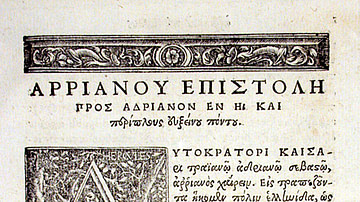
Periplus of the Euxine Sea by Arrian
Beginning of the Periplus of the Euxine Sea by Arrian of Nicomedia, Johann Froben and Nicolaus Episcopius, Basel 1533. Basel University Library. The Periplus of the Euxine Sea (Latin: Periplus Ponti Euxini, Greek...
Image
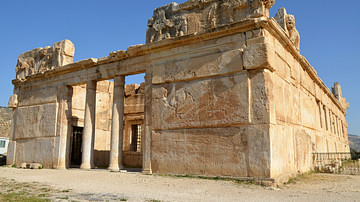
Hellenistic Palace Qasr Al-Abd
Qasr Al-Abd is a Hellenistic palace dating from approximately 200 BCE whose ruins stand in western Jordan, approximately 17 kilometers west of Amman. It is a two-story stone structure (measuring about 40 meters by...
Image
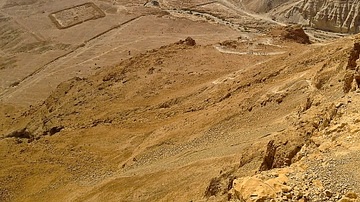
Roman Camps at Masada
Following the fall of Jerusalem in 70 CE, Roman Governor Flavius Silva dispatched Legion X Fretensis - a veteran military unit - to eliminate the remaining centre of Jewish resistance at Masada in 72-73 CE. Josephus describes...
