
Search
Did you mean: Kish?
Remove Ads
Advertisement
Search Results

Image Gallery
Marine Life in Ancient Mediterranean Art
Throughout the history of the ancient Mediterranean artists were always keen to express their appreciation of the bounty of the sea. Marine life of all kinds, real and imagined, was frequently depicted on frescoes...

Article
The Mesopotamian Pantheon - The Ancient Gods and Goddesses of the Near East
The gods of the Mesopotamian region were not uniform in name, power, provenance or status in the hierarchy. Mesopotamian culture varied from region to region and, because of this...

Article
Traditional Maori Tattoo of New Zealand
Te Papa Tongawera (or simply Te Papa) is New Zealand's innovative national museum situated near the foreshore of beautiful Wellington harbour. Te Papa Tongawera means “container of treasures” in Te Reo Maori...
Article
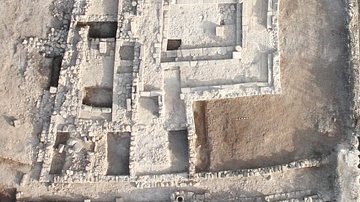
The Archaeological Excavations at Magdala
Magdala, known as Migdal in Hebrew (מִגְדָּל: tower) and also as Taricheae (Ταριχέα, from the Greek Τάριχος or tarichos: preserved by salting or drying fish), was an important fishing town during the first...

Article
Wall Reliefs: Apkallus of the North-West Palace at Nimrud
Religion is the sigh of the oppressed creature, the heart of a heartless world, and the soul of soulless conditions. It is the opium of the people. (Karl Marx, Critique of Hegel's Philosophy of...

Article
The Magical Lullaby of Ancient Egypt
The Magical Lullaby (popularly known as Charm for the Protection of a Child) is an inscription from the 16th or 17th century BCE. The poem exemplifies the ancient Egyptian's personal religious and spiritual practices...

Article
The Book of Jonah
The book of Jonah is the fifth book in the Christian canons and the Jewish Tanakh. It is one of 'Trei Asar' (The Twelve) prophets in the tanakh, and in Christian tradition as 'oi dodeka prophetai' or 'ton dodekapropheton'...

Article
How to Read a Maya Glyph
For over three centuries, the ancient Maya flourished in Mesoamerica. They built giant stone pyramids surrounded by dense jungle, used a calendrical system that made many believe that 2012 would be the end of the world...

Article
Wine Culture in the Hellenistic Mediterranean
The culture of drinking wine was enjoyed throughout the Mediterranean world, and what is true now was true in antiquity, too: wine is always good business. The Hellenistic Period (c. 335-30 BCE), between...

3D Image
Colima Culture Fish-shaped Vase
Fish-shaped vase (American scorpion fish?), Western Mexico - Colima - Colima culture - Colima style - Preclassic recent - Classic old 200 BCE - 300 CE, terracotta. Musée d'Art et d'Histoire (Musée du Cinquantenaire...
