
Search
Search Results
Article
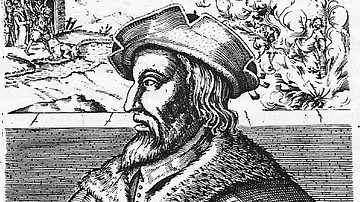
Hubmaier's Concerning Heretics and Those Who Burn Them
Balthasar Hubmaier (l. 1480-1528) was a Catholic theologian who converted to the Protestant Anabaptist sect in 1525. His Concerning Heretics and Those Who Burn Them (1524) was a plea for religious tolerance written prior to his conversion...

Article
The AlUla World Archaeology Symposium 2024 - Three Days of Learning and Sharing Amongst Archaeologists
I was recently invited to an archaeological symposium at the site of AlUla in Saudi Arabia. I had known about AlUla since 2018 and seen photographs of the amazing Nabatean tombs from there. A conference was held at AlUla in 2023, but I was...

Interview
Tutankhamun and the Tomb that Changed the World with Dr. Bob Brier
Join World History Encyclopedia as they sit down with Dr. Bob Brier to chat all about his new book Tutankhamun and the Tomb That Changed the World, published by Oxford University Press. Kelly: Welcome. Thank you so much for joining me today...

Video
Eros-Cupid and Psyche, the Greek and Roman Gods of Love and the Soul
Eros in Greek mythology, known as Cupid in Rome, is the god of love but more specifically, the god of physical and passionate desire. He is often referred to as a son and attendant of Aphrodite (Venus), the goddess of love and beauty, and...

Video
Friendships in History: Alexander and Hephaestion // David and Jonathan // Enkidu and Gilgamesh
Friendships in History, especially from mythology and the ancient world have withstood the test of time. This video will take you through the close friendships of Alexander the Great and Hephaestion, David and Jonathan and Enkidu and Gilgamesh...

Video
Roman Politics and Poetry: Cicero and Catullus
The Roman love poet Catullus wrote passionate poems about his tempestuous relationship with 'Lesbia', as well as obscene diatribes about high profile contemporaries like Julius Caesar. In this vodcast Dr Rhiannon Evans and Dr Sonya Wurster...

Definition
Mesopotamian Science and Technology - Scientific Method in the Ancient Near East
Mesopotamian science and technology developed during the Uruk period (circa 4000-3100 BCE) and the Early Dynastic period (circa 2900-2350/2334 BCE) of the Sumerian culture of southern Mesopotamia. The foundation of future Mesopotamian advances...

Definition
Akkad and the Akkadian Empire - The First Multinational Empire in the World
The city of Akkad was the seat of the Akkadian Empire (2350/2334-2154 BCE), the first multinational political entity in the world, founded by Sargon the Great, who unified Mesopotamia under his rule and set the model for later Mesopotamian...

Article
Ancient Persian Gods, Heroes, and Creatures - The Complete List
The term 'mythology' comes from the Greek mythos (story-of-the-people) and logos (word or speech), meaning the spoken story of a people. Every civilization of the ancient world developed a belief system, which is characterized as 'mythology'...

Definition
Hypatia of Alexandria
Hypatia of Alexandria (c. 370 - March 415) was a female philosopher and mathematician, born in Alexandria, Egypt possibly in 370 (although some scholars cite her birth as c. 350). Little is known of her life but her dramatic death at the...
