
Search
Did you mean: Egyptian Empire?
Remove Ads
Advertisement
Search Results

Definition
Second Intermediate Period of Egypt - The Era of the Hyksos
The Second Intermediate Period (circa 1782 to circa 1570 BCE) is the era following the Middle Kingdom of Egypt (2040-1782 BCE) and preceding the New Kingdom (circa 1570-1069 BCE). As with all...

Article
The Temple of Hatshepsut
Among the duties of any Egyptian monarch was the construction of monumental building projects to honor the gods and preserve the memory of their reigns for eternity. These building projects were not just some grandiose...

Article
Interrelations of Kerma and Pharaonic Egypt
The vacillating nature of Ancient Egypt's associations with the Kingdom of Kerma may be described as one of expansion and contraction; a virtual tug-of-war between rival cultures. Structural changes in Egypt's...

Article
The Temple of Apollo at Didyma
Located about 11 miles south of the ancient port city of Miletus on the western coast of modern-day Turkey, the Temple of Apollo at Didyma or Didymaion was the fourth largest temple in the ancient Greek world. The...

Definition
Temple of Garni
The Temple of Garni (Armenian: “Garnu tacar”) is located in the village of Garni in Kotayk Province, Armenia, and it was once a pagan temple dedicated to the Armenian sun god Mihr. Built in the middle of the 1st century CE, the...

Article
Ancient Egyptian Science & Technology
The great temples and monuments of ancient Egypt continue to fascinate and amaze people in the modern day. The sheer size and scope of structures like the Great Pyramid at Giza or the Temple of Amun at Karnak...
Article
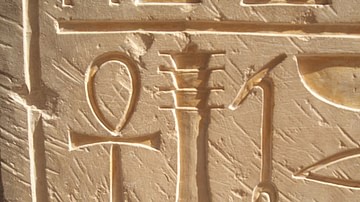
Ancient Egyptian Symbols
Religion in ancient Egypt was fully integrated into the people's daily lives. The gods were present at one's birth, throughout one's life, in the transition from earthly life to the eternal, and continued their care for...

Definition
Ancient Egyptian Law
Ancient Egyptian culture flourished through adherence to tradition and their legal system followed this same paradigm. Basic laws and legal proscriptions were in place in Egypt as early as the Predynastic Period (c. 6000-...

Article
Egyptian Afterlife - The Field of Reeds
The ancient Egyptians believed that life on earth was only one part of an eternal journey which ended, not in death, but in everlasting joy. When one's body failed, the soul did not die with it but continued...

Article
Rome's Egyptian Heritage
The Eternal City of Rome is one of the places in the world with the most historical sites to visit. The list of ancient ruins, museums, churches, and other historical landmarks makes the city an Eldorado for anyone interested...
