
Search
Remove Ads
Advertisement
Search Results
Image
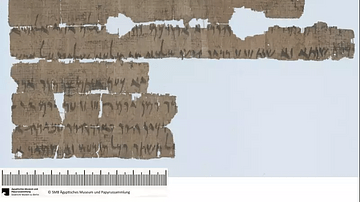
The Passover Papyrus from Elephantine
A papyrus letter, written in Aramaic, from the fortified island of Elephantine in Egypt. The letter was written c. 419 BCE by a Jewish man named Hananiah and is addressed to his brother Jedoniah and the rest of...
Video
Ancient Egyptian papyrus in the Book of the Dead exhibition at the British Museum
Preparing pieces of papyrus ready for display in the exhibition Journey through the afterlife: ancient Egyptian Book of the Dead

Definition
Ancient Egyptian Literature
Ancient Egyptian literature comprises a wide array of narrative and poetic forms including inscriptions on tombs, stele, obelisks, and temples; myths, stories, and legends; religious writings; philosophical works; wisdom...

Article
The Tale of Sinuhe
The Middle Kingdom of ancient Egypt (2000 BCE – 1700 BCE) saw the start of more formal writing which included religious scripts, administrative notes, and more in-depth fictional writing. One of the most iconic pieces of writing...

Image
Negative Confession, Papyrus of Ani
Ani's soul is acquitted after the Negative Confession.

Image
Papyrus Chester Beatty VI
Dated to the New Kingdom (c. 1570 - c. 1069 BCE), and specifically to c. 1200 BCE, the text is written in demotic script and is the oldest treatise on anorectal disease (affecting the anus and rectum) in history.
Image
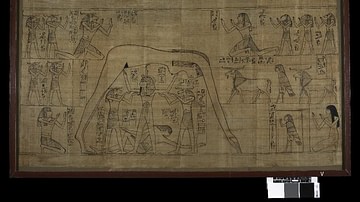
The Greenfield Papyrus
Book of the Dead of Nestanebtasheru (sheet 87): Geb is shown as a semi-recumbent figure stretching out his limbs while the elongated body of Nut arches above him. Her feet touch the ground at the eastern horizon and her fingers...

Image
Papyrus Anastasi V
Prayer to Thoth for skill in writing. The prayer is written in hieratic script, found at Thebes sometime prior to c. 1830 CE, and purchased by the British Museum in 1839 CE from the collector Giovanni Anastasi.
Image
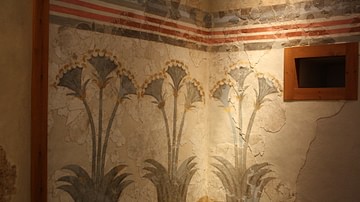
Papyrus Fresco, Akrotiri
The Papyrus Fresco from the Room of the Ladies from the house of the same name, Akrotiri, Thera. Papyrus is not indigineous to Thera and therefore suggests that the Cycladic artists were borrowing iconography from elsewhere...

Image
Papyrus of Ani
The Papyrus of Ani, a text of The Egyptian Book of the Dead, was prepared for the priest Ani of Thebes (c. 1250 BCE) and included among the grave goods of his tomb. It includes a number of chapters from the Book of the Dead.
