
Search
Remove Ads
Advertisement
Search Results

Definition
Isthmia
Isthmia is a genitive noun with the meaning 'of the Isthmus.' It generally refers to the site that held the famous Isthmian Games near Corinth on the Isthmus. A natural assembly place for many Greeks and travellers. Isthmia in Antiquity...

Definition
Mandala
A mandala (Sanskrit for “circle”) is an artistic representation of higher thought and deeper meaning given as a geometric symbol used in spiritual, emotional, or psychological work to focus one's attention. The image first appears in...

Definition
Statue of Zeus at Olympia
The monumental statue of Zeus at Olympia in Greece was one of the Seven Wonders of the Ancient World. Created in the 430s BCE under the supervision of the master Greek sculptor Phidias, the huge ivory and gold statue was...
Definition
Epidaurus
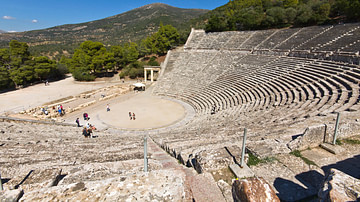
Epidaurus was an ancient religious site and settlement located on the fertile Argolid plain of the east Peloponnese in Greece. Blessed with a mild climate and natural springs, the sanctuary of Asclepius at Epidaurus was an important...

Definition
Nemea
Nemea was a religious sanctuary in the northern Peloponnese of Greece where pan-Hellenic athletic games were held every two years from 573 BCE until 271 BCE, after which, the Games were definitively moved to Argos. Early Settlement...

Definition
Kos
Kos (Cos) is a Greek island in the south-east Aegean, part of the Dodecanese (ancient Sporades) group which prospered in antiquity due to its location on trade routes between Egypt, Syria, Cyprus, and Anatolia. Settled from the Bronze Age...

Definition
Yamm
Yamm (from the Semitic word yam for 'sea', also known as Yam and Yam-Nahar) was the god of the sea and storm in the pantheon of the Canaanite-Phoenicians. Depicted consistently as tyrannical, angry, violent, and harsh, Yamm was the brother...

Image
Knights Hospitaller
An illustration by Ralph Hammann showing members of the medieval military order the Knights Hospitaller. Soultz commandery, France.

Article
Medieval Knights: 12 of the Best
The knights of medieval Europe were meant to be the finest fighting men of their age, even more important, they were expected to be pure in thought and deed, as exemplified in the chivalrous code which they (usually...

Image
Map of Settlement & Mobility in the Aegean, c. 1100-550 BCE - Migration, Memory, and the Making of the Hellenic World
The collapse of the Mycenaean palatial system (c. 1200–1100 BCE) initiated a prolonged period of demographic, political, and cultural reorganization...
