
Search
Remove Ads
Advertisement
Search Results
Definition
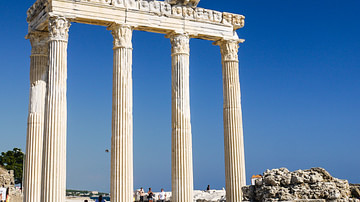
Side
Side (pronounced see-day) was a city on the southern coast of Cilicia (modern-day Turkey) first settled in the 7th century BCE by immigrants from Cyme, an Aeolian municipality to the north near the kingdom of Lydia. Its name means 'pomegranate'...

Definition
Aria
Aria (or Areia) was always understood to be the area around the Areios River, today Hari Rud in Afghanistan (Arrian, Anabasis IV.6.6). It was bounded to the north by Margiana and Bactria, where the area of the Margos River begins; to the...

Image
Map of the Hellenistic Kingdoms after Alexander, c.301 BCE
The Hellenistic Successor Kingdoms (the Diadochi, from the Greek for “Successors”) emerged after the death of Alexander the Great in 323 BCE, when his vast empire fractured among his generals. From this division arose powerful states such...

Article
The Life of Diogenes of Sinope in Diogenes Laertius
Diogenes of Sinope (c. 404-323 BCE) was a Greek Cynic philosopher best known for holding a lantern to the faces of the citizens of Athens claiming he was searching for an honest man. He was most likely a student of the philosopher Antisthenes...

Article
Pilgrimage in the Byzantine Empire
Pilgrimage in the Byzantine Empire involved the Christian faithful travelling often huge distances to visit such holy sites as Jerusalem or to see in person relics of holy figures and miraculous icons on show from Thessaloniki to Antioch...

Article
Pausanius' Guide To Ancient Athens
Pausanius (l. 110-180 CE) was a geographer and historian who traveled extensively, taking notes on points of interest, then wrote on them in guide books which could be used by tourists visiting the sites described. His works have long been...

Article
Ten Ancient Persia Facts You Need to Know
Ancient Persian culture exerted a powerful influence throughout the Near East, and beyond, for over a thousand years between c. 550 BCE - 651 CE and many aspects of their culture continued to influence others afterwards and up through the...

Article
The Great Jewish Revolt of 66 CE
The Roman Empire in the early 1st century CE was often regarded as the perfect empire. The outstanding military prowess of the Romans was used to expand the empire, and once the territories were acceptably pacified, Roman political power...

Article
Achaemenid Kings List & Commentary
The Achaemenid Empire (c. 550-330 BCE) was the first great Persian political entity in Western and Central Asia which stretched, at its peak, from Asia Minor to the Indus Valley and Mesopotamia through Egypt. It was founded by Cyrus II (the...

Article
Parthia: Rome's Ablest Competitor
As a superpower in its own right and in competition with Rome, Parthia's empire - ruling from 247 BCE to 224 CE - stretched between the Mediterranean in the west to India in the east. Not only did the Parthians win battles against Rome they...
