
Search
Did you mean: Darius I?
Remove Ads
Advertisement
Search Results

Definition
Argead Dynasty
The Argead dynasty, the ancient Macedonian house of Dorian Greek origin, lasted from the 7th century to 310 BCE. The mythological founder of the dynasty was King Caranus but it was under Philip II of Macedon (382-226 BCE) that...

Article
Alexander the Great as a God
The age-old concept of the “divine right of kings” allowed that a country's ruler received his or her power or authority from God. However, few, if any, were delusional enough to actually believe themselves to be a god...

Definition
Scythian Warfare
Scythian warfare used state-of-the-art recurve bows and hit-and-run tactics against set infantry formations. Working from nimble horses, Scythian warriors could unleash a cloud of lethal arrows. Known, too, for their innovative...

Definition
Assyria
Assyria was the region located in the ancient Near East which, under the Neo-Assyrian Empire, reached from Mesopotamia (modern-day Iraq) through Asia Minor (modern Turkey) and down through Egypt. The empire began modestly at the city...

Definition
Neo-Assyrian Empire
The Neo-Assyrian Empire (912-612 BCE) was the final stage of the Assyrian Empire, stretching throughout Mesopotamia, the Levant, Egypt, Anatolia, and into parts of Persia and Arabia. Beginning with the reign of Adad Nirari...
Definition
Scythians
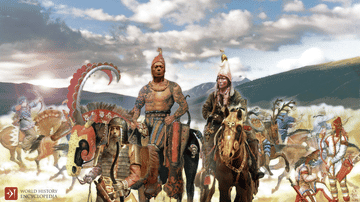
The Scythians were a nomadic people whose culture flourished between the 7th and 3rd century BCE in a territory ranging from Thrace in the west, across the steppe of Central Asia, to the Altai Mountains of Mongolia in the east. This...

Definition
Ptolemaic Dynasty
The Ptolemaic dynasty was a Macedonian royal family that ruled Ptolemaic Egypt from 323 to 30 BCE. It was founded by Ptolemy I, a general and successor of Alexander the Great. They built Alexandria, including the Lighthouse of...

Article
The Army of Alexander the Great
No military commander in history has ever won a battle by himself. To be successful he needs the support of a well-trained army who will follow him regardless of the cost whether it be a stunning victory or hopeless...

Article
Sassanian Kings List & Commentary
The Sassanian Empire (224-651) was the greatest expression of Persian culture in the ancient world. It was consciously modeled on the earlier Achaemenid Empire (c. 550-330 BCE) which established Persian supremacy...

Definition
Ahura Mazda
Ahura Mazda (also known as Ahuramazda, Harzoo, Hormazd, Hourmazd, Hurmuz, Ohrmazd, 'Lord' or 'Spirit') is the highest spirit worshipped in Zoroastrianism, the old Mede and ancient Persian mythology which spread across Asia predating...
